Collections
The Money Museum houses extensive monetary history collections comprising banknotes, coins, securities and historical designs. With around 80,000 objects, they rank among Austria’s largest numismatic collections. Some of their unique pieces date back to the Bronze Age and tell the story of money across thousands of years.
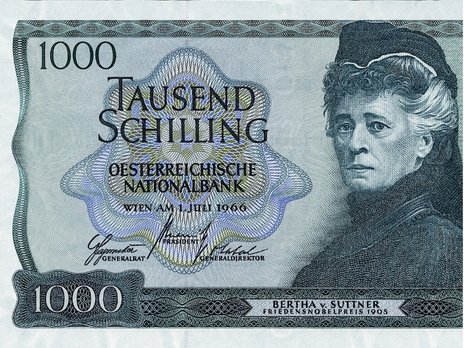
Banknote collections
The Money Museum holds an extensive collection of banknotes from Austria and around the world. The two oldest banknotes in the collection are 700 years old and come from China. The oldest European banknotes in the collection are considerably younger and date from the early 18th century. The core of the collection consists of official Austrian paper money from the reign of Maria Theresa to the present day. It includes numerous rare examples, such as various issues of Stadt-Banco-Zettel.
A substantial subcollection is dedicated to substitute currencies, which can complement an official national currency in speicific circumstances. These include emergency banknotes, prison currency, military currency and modern regional currencies.
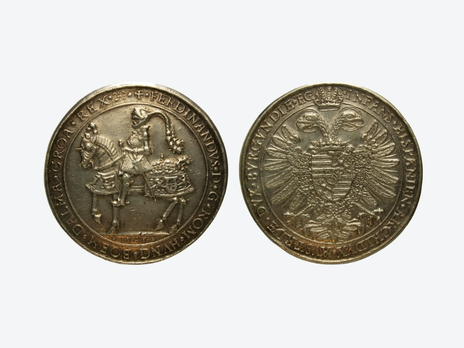
Coins
The OeNB’s coin collection has been systematically expanded since the 1950s. Its primary focus is the monetary history of the Austrian region – with particularly important holdings relating to Habsburg coinage and coins from the Archbisphoric of Salzburg.
Over time, the collection has been enriched by significant individual acquisitions and entire collections covering European and international monetary history. Highlights include the Salzburg Rübentaler of 1504, a 100-ducat coin of Emperor Ferdinand III. (1629), the Leypold collection of provincial Roman coins and the Ferrari-Kellerhof collection of historical Tyrolean coins.
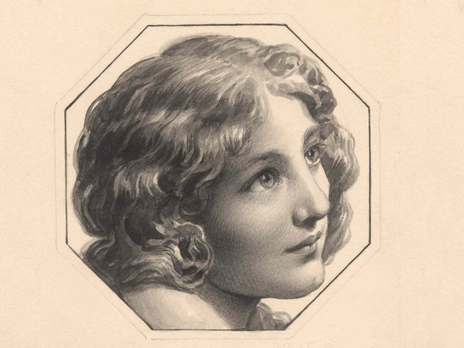
Drawings and designs
Since 1816, numerous renowned Austrian artists have contributed to the design of banknotes, including Koloman Moser, Gustav Klimt, Erika Giovanna Klien and Berthold Löffler. Their work is reflected in original drawings, designs sketches, trial prints and paper samples that today form part of the OeNB’s monetary history collections.
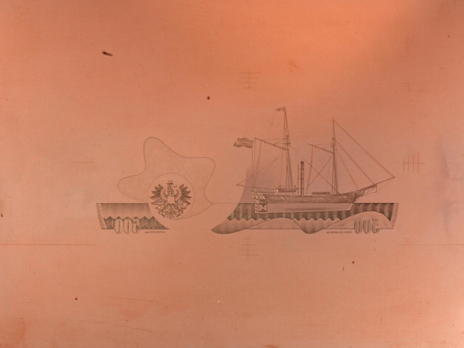
Printing and production technology
One of the most fascinating areas of the collections from a technological perspective is printing and production technology. Unique in Austria, it includes historical printing plates dating back to 1816, glass negatives, films, screens and other materials used in banknote production. These objects provide fascinating insights into the development of printing technology and document the craftsmanship and technological expertise behind the production of money.
Shares and securities
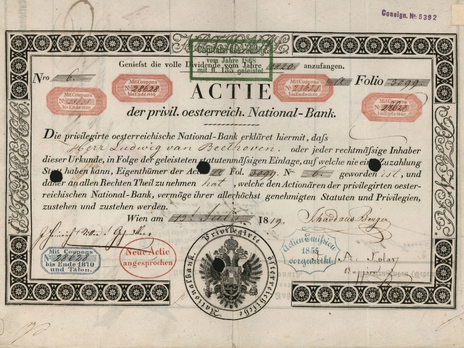
Shares and securities form a particularly important group of objects from an economic history perspective. The collection includes numerous historical documents from Austria and abroad that illustrate the development of financial markets and corporate history.
A particular highlight is a pair of shares in the Privilegierte Oesterreichische Nationalbank issued in 1819 and registered to Ludwig van Beethoven. These unique items create a remarkable link between monetary history and cultural history.
Historical counterfeits
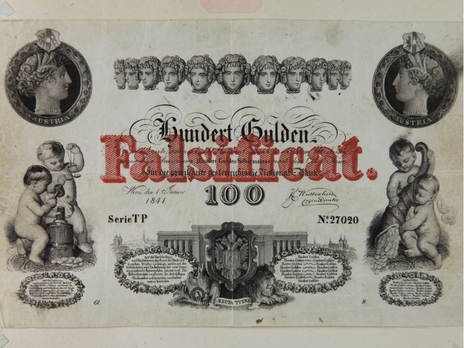
Combating counterfeiting is one of the OeNB’s responsibilities and is carried out in close cooperation with the security authorities. Representative examples of detected counterfeits are archived for documentation purposes.
Historical counterfeits that are no longer required for investigative purposes – such as “Stadt-Banco-Zettel” from around 1800 or the counterfeit Austrian banknotes produced by Bohr from 1816 onwards – have been incorporated into the Money Museum’s collections.
They provide valuable insights into the history of counterfeiting and complement the OeNB’s monetary heritage.
Alternative means of payment
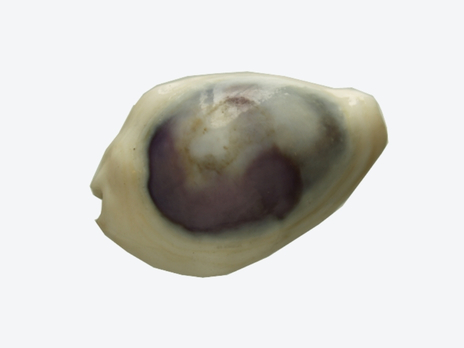
The Money Museum’s most diverse collection contains some of the oldest objects in its monetary history holdings. It ranges from pre-monetary means of payment, such as Bronze Age scythes, dog tooth money and cowrie shells to historical bar money and modern-day plastic money.
The collection also includes half-official means of payment with limited validity, such as factory stamps, emergency coins and similar. Together, they demonstrate the many different ways in which money has been conceived, designed and used throughout history.
Museum objects
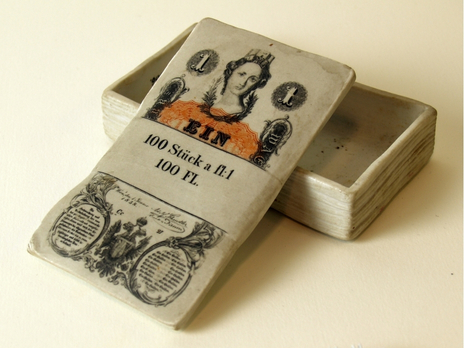
This collection provides the wider context for the Money Museum’s other collections. Rather than focusing on means of payment, it explores the cultural history of money. The collection brings together a wide variety of objects. Wallets, money-handling devices, savings books, money boxes, historical books and documents illustrate how people have used and interacted with money in their daily lives.
Related links
- Wiener Stadt-Banco – Zettel
- Schilling-Banknoten der Oesterreichischen Nationalbank 1925–1938
- Kronen-Banknoten der Oesterreichisch-ungarischen Bank
- Gulden-Banknoten der privilegirten Oesterreichischen National-Bank, Österreichische Währung
- Gulden-Banknoten der privilegirten Oesterreichischen National-Bank, Konventionsmünze
- Gulden Wiener Währung
- Alliierte-Militärschilling-Noten, Serie 1944
- Schilling-Banknoten der Oesterreichischen Nationalbank