External trade
The Austrian economy is strongly integrated into the global economy. The balance of payments captures these close international trade relations. Austria’s most important trade partners are the countries of the euro area, especially Germany, as well as the USA, China and Switzerland.
Facts about external trade
Balance of payments
The balance of payments is an important tool for economic policy analysis. It allows conclusions about the international integration and stability of a national economy in an international context. It records all economic transactions with other countries. This applies both to the real economy – trade in goods and services, income from employment and capital, and transfer payments – and to the financial sector, i.e. international capital flows comprising foreign direct investment (cross-border corporate investments), portfolio investment (cross-border investment in securities), other investments (cross-border loans and bank deposits) and cross-border financial derivatives, as well as foreign exchange reserves.
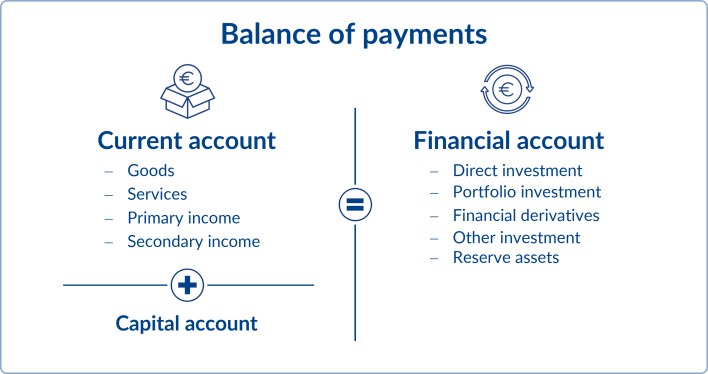
Developments in the real economy are primarily reflected in the current account and in capital transfers, while financial transactions are reflected in the capital account.
The international investment position (IIP) shows financial assets and financial liabilities vis-à-vis other countries – in contrast to the capital account, which reflects financial transactions. Methodically, it builds upon the international conventions introduced by the IMF’s Balance of Payments Manual and the System of National Accounts.