Key facts
The digital euro would be an electronic means of payment that everyone in the euro area could use conveniently and free of charge. Like cash, it would be secure and safeguard users’ privacy.
Digital payments are part of our everyday lives: We pay by card in shops or online. And we use mobile apps and other electronic payment solutions. However, many of these solutions were developed in countries outside Europe or by major international corporations.
As a legal electronic means of payment, the digital euro could be used, and would be accepted, free of charge throughout the euro area. As public money, it would be guaranteed by the European Central Bank. Today, private individuals can only access central bank money in the form of cash.
Available in the euro area at no extra cost – even offline
Free basic services
Digital euro payments and other basic services would be free of charge for all users.
Also available offline
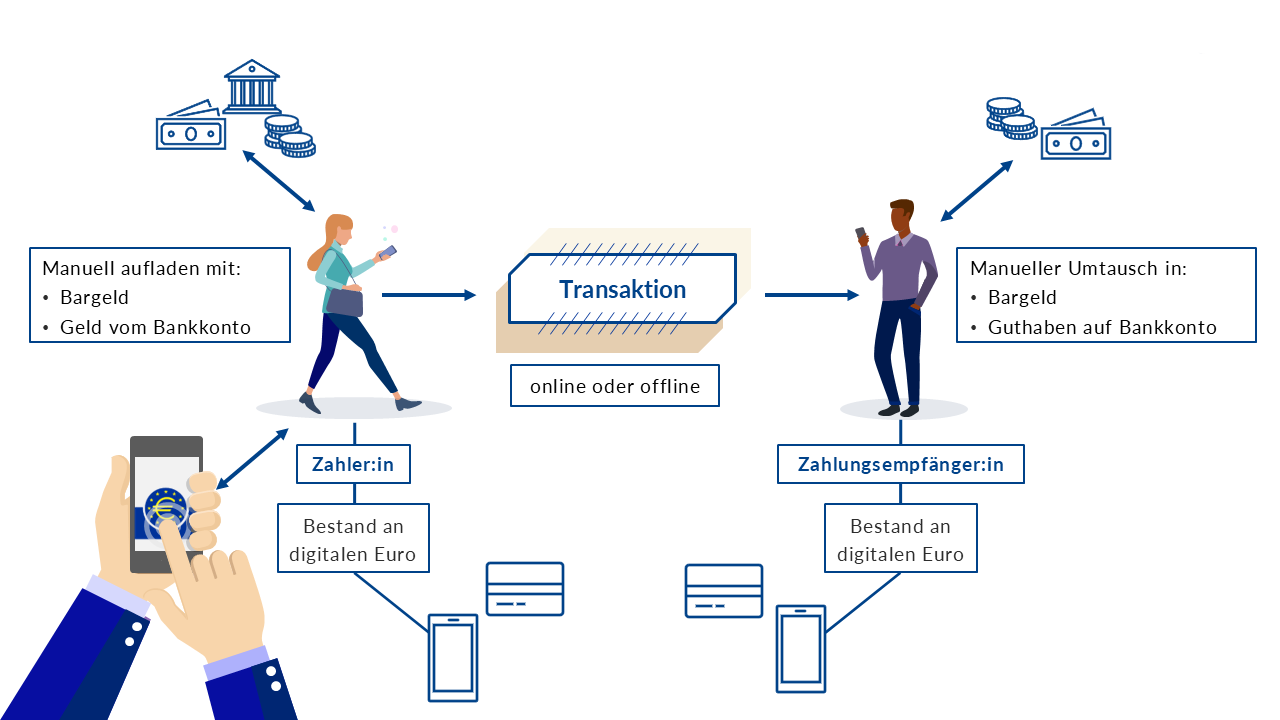
Even without an internet connection, you would be able to use the digital euro to pay in shops or transfer money to friends.
Trusted partners
The digital euro would be available through banks and payment service providers.
Benefits
Why does Europe need a digital euro?
Today, there is no digital payment option in Europe that covers the entire euro area.
The digital euro would close this gap and
- make public central bank money fit for the digital future,
- offer greater choice about how to pay,
- benefit all market participants,
- be a secure European solution for electronic payments,
- make European payments more competitive and resilient and
- contribute to Europe’s strategic independence.
This is important because foreign providers currently dominate the European payments landscape. In the euro area, around two-thirds of all electronic retail payments are processed in accordance with the specifications of just two non-EU payment service providers. In Austria, such payments account for more than 90% of all payments.
Furthermore, the digital euro would strengthen the euro area’s strategic autonomy. This is important to ensure that the Eurosystem can continue to conduct monetary policy independently in the future.

Was bringt der digitale Euro verschiedenen Marktteilnehmer:innen?
Consumers
In addition to using cash, everyone in the euro area could also make digital payments using central bank money. Paying with the digital euro would be free of charge throughout the euro area and would also be possible offline – in shops, online, for public services and between private individuals.
The digital euro would guarantee unrivalled privacy protection: commercial digital payment methods cannot match this. The Eurosystem would not be able to identify individuals on the basis of their payments. Unlike commercial providers, the central banks issuing the digital euro do not pursue commercial interests and do not trade in data.
People who need support would also have access to a public electronic means of payment that is easy to use. With a card, it would be possible to use the digital euro even without a bank account or a digital device.

Retailers
The digital euro would have the advantage that fees for retailers would be comparatively lower. For their customers, the digital euro would be an attractive additional payment option. The digital euro would therefore provide retailers with an additional means of accepting payments from consumers throughout the euro area.
This would make the payments system more robust and boost competition. Retail costs would go down. In such an environment, the cost savings would be passed on to consumers.
Furthermore, the digital euro would be a pan-European platform on which market participants could offer additional innovative services.

Supervised banks and payment institutions
Banks and payment institutions could offer innovative payment and financial services based on the digital euro across the euro area. This would also increase competition in e-commerce and electronic payments.
They would therefore depend less on the handful of companies that currently dominate cross-border payments. Settlement costs would decrease. The Eurosystem would bear its own costs, including the costs for running the system and for settlement processing.
Banks and payment institutions would not have to pay any direct transaction fees for using the digital euro’s core infrastructure and basic payment functions provided by the Eurosystem. Thanks to this cost-effective foundation, they could develop innovative services and scale them up in the euro area.
The digital euro guarantees:
A stable and trusted currency
The ability to convert bank deposits not only into cash but also into digital central bank money instils confidence in the currency. Trust in the currency fosters stability. The digital euro would therefore serve as an anchor of stability.
Autonomous and innovative payments
A common European system would reduce dependence on non-European payment providers. The digital euro would also provide a platform for innovation for all financial institutions in the euro area. Increased competition would lower costs.
Inclusive financial services for all
The digital euro would provide everyone in the euro area with free access to financial services. You could use it to pay for your shopping, both online and in-store. Just like cash, you could also exchange digital euro privately.
The OeNB’s position on the digital euro
-
Additional choice about how to pay & a complement to cash
The OeNB supports the view that the digital euro should complement, but not replace, cash.
-
Freedom of choice for citizens
The OeNB supports the view that citizens can use the digital euro, but are not obliged to do so.
-
Mandatory acceptance by businesses
The OeNB supports the view that businesses should be required to accept the digital euro (subject to reasonable exceptions).
-
Free of charge
The OeNB supports the view that citizens should be able to use the digital euro like cash, free of charge.
-
User-friendly
The OeNB supports the digital euro as a means of making life easier for citizens across the euro area, particularly in places where cash cannot be used, or where its use is difficult. It should be possible to pay with the digital euro anywhere in the euro area.
-
European payments
The OeNB supports the digital euro, as it makes payments within the euro area independent of non-European payment service providers.
-
Security & privacy
The OeNB supports the digital euro as a secure and user-friendly payment method that protects privacy, as central banks do not receive any customer data.
OeNB's position on cash
Position der OeNB
- The evolution of money: The digital euro would represent the next step in the evolution of cash for the digital world, much like banknotes once evolved from coins centuries ago.
- Making everyday life easier: The digital euro would provide a new payment method that could be used in most payment situations and throughout the euro area. Its universal acceptance would make day-to-day payments easier for consumers.
- Greater resilience: Everyday payment services are essential to people and the economy, much like electricity or water. People expect public institutions to ensure that these services remain available to everyone and that no one is left behind. The digital euro would help reduce Europe’s dependence on non-European payment solutions.
Comparing apples and oranges: Developments in crypto assets are not relevant to the digital euro. The confusion arises because the term “digital currencies” is often used to talk about both crypto assets, such as bitcoin, and the digital euro.
In reality, they have nothing in common. Bitcoin is not a currency because it does not serve as a medium of exchange or a unit of account. Instead, it serves as a speculative asset.
The digital euro, by contrast, is a liability of the central bank.
People who wish to speculate in crypto assets would still be free to do so under the applicable legal framework, regardless of whether a digital euro is introduced.
An additional payment method: The digital euro would not only complement cash but also existing private electronic payment solutions. In a dynamic and growing market, the digital euro and private Europe-wide payment solutions can complement one another. Both can help make instant payments more widely available. Investments that banks have made in their IT systems to comply with the Instant Payments Regulation would also pay off for the digital euro. After all, both solutions require payments to be processed in real time.
At the same time, the digital euro would address additional structural weaknesses in the European payments landscape, which could not be remedied through the EU’s Instant Payments Regulation alone.
Furthermore, the standards introduced for the digital euro could facilitate the development of euro area-wide retail payment solutions based on instant payments. This would help reduce Europe’s dependence on non-European providers, which currently handle the vast majority of point-of-sale payments and e-commerce payments across the euro area.
- One payment solution for every occasion, available anytime: There is currently no European digital payment method that is accepted throughout the entire euro area. While euro cash has provided a common means of payment since 2002, an equivalent solution for digital payments does not yet exist.
- A payment solution with cash-like features: The digital euro could be used in situations where cash cannot be used, such as e-commerce payments or remote payments between two individuals (peer-to-peer transactions). In all these situations, it would keep the key features people value about cash: strong privacy protection, free basic services, offline functionality and ease of use.
- A payment method designed with privacy in mind: For offline payments in digital euro, personal transaction details would only be known to the person making the payment and the person receiving it. For online payments, personal data would not be passed on to third parties, unless such data are required by European law to prevent illegal activities. Accordingly, by using privacy-enhancing technologies, the ECB would not be able to identify users based on their payment transactions.
- A payment solution that leaves no one behind: As a public good, the digital euro would be designed to ensure that payments are accessible to everyone and that no one is left behind. The ECB would provide an easy-to-use app available in all euro area languages and equipped with accessibility features for people with disabilities. Physical payment cards would also be available through supervised payment service providers for users without a mobile device. Finally, the proposed legislation provides for personal assistance to help people get started with using the digital euro.
- More efficient payments: The digital euro would be a payment solution that works across the entire euro area. This could make things simpler for retailers, as they would no longer need to navigate today’s fragmented payments landscape. Furthermore, the availability of a public payment option could help maintain pressure to keep the payments market cost-effective, particularly for small and medium-sized companies. Lower costs could ultimately benefit end consumers as well.
- Easy payments: Customers are less likely to abandon an online purchase during the checkout process if they are familiar with the payment method available. This is particularly important in e-commerce.
- Instant payment receipt: With the digital euro, retailers could receive the money in their account immediately and at no extra cost.
- A platform for innovation: Banks and other payment service providers would be able to preserve their relationships with end users and remain their providers of choice. Today, private-sector innovations mainly cater to national markets. The digital euro, however, would offer seamless reach throughout the euro area. In addition, digital euro standards could promote the further development and wider adoption of instant payment solutions, including in situations where they are currently under-represented, such as point-of-sale payments.
- A neutral compensation model: According to the compensation model set out in the legislative proposal, payment service providers would receive compensation for digital euro transactions comparable to that received for transactions made using private payment solutions. Payment service providers would also be able to offer a wide range of additional and innovative services built on or complementary to the digital euro, going beyond the basic services provided to consumers at no cost.
Retaining seigniorage, that is, income earned on banknotes in circulation: If demand for cash as a store of value were to decrease in the future, governments would still have an interest in maintaining seigniorage income.
How is seigniorage income generated? Commercial banks are responsible for distributing euro banknotes to people across the euro area. They purchase the banknotes from central banks at face value. To do so, banks either borrow funds from their respective central bank or provide assets as collateral. The central bank then earns interest on the money it lends, or receives a return on the acquired assets, thus generating seigniorage income.
- Easy access for everyone: Everyone in the euro area should be able to easily access and use the digital euro for payments, no matter which bank they use or in which member state they live. Getting access to the digital euro should be as simple as obtaining euro banknotes.
- Broad acceptance: Citizens will expect to be able to pay with the digital euro just as easily as they do with cash today. Retailers that accept digital payment methods should therefore also accept the digital euro. The same applies to e-commerce, which currently accepts only private payment methods rather than cash.
- Available through your own bank: Citizens will also expect to obtain the digital euro through their bank, just as they do with cash today. Users who wish to access the digital euro should not face any obstacles. They should not have to switch banks in order to be able to use it.
According to the EU Commission‘s legislative proposal from June 2023, digital euro users may have one or several digital euro payment accounts with the same or different payment service providers.
For mobile payments, users could use their payment service providers’ mobile apps to make and receive payments, just as they can today. In addition, the ECB could also offer its own digital euro app, which users would be free to choose instead.
For smaller transactions conducted between devices that are physically close to one another, mobile payments in digital euro would also be possible without an internet connection. To store digital euro securely, users could rely on the EU Digital Identity Wallet, which was proposed by the European Commission to facilitate access for individuals and businesses to both public and private online services.
- Free basic services for end users: The proposed compensation model follows a balanced approach. Citizens would be able to use basic services such as spending, holding, or receiving digital euro free of charge. At the same time, economic incentives would be created for retailers accepting the digital euro and for payment service providers, such as banks, distributing it.
- Opportunities for payment service providers: Payment service providers could generate revenue in particular by offering services that go beyond the basic features, such as innovative add-on services or optional payment solutions. In addition, they would earn indirect revenue through regulated merchant service charges and inter-PSP fees. However, these fees would be capped and subject to strict regulation.
- The role of the Eurosystem: The Eurosystem would bear the costs of building and running the digital euro’s core infrastructure, just as it currently bears the costs of issuing euro cash. Payment service providers would not have to pay direct participation fees.
- Regulated pricing and safeguards: Pricing would not be determined solely by market dynamics, but will be guided by regulatory requirements. These would include, in particular, fee caps designed to ensure that retailers are not charged more than they are for comparable payment methods and that they are generally protected against excessive costs.
The digital euro ecosystem would be protected by a comprehensive cyber resilience framework, comparable to the one already in place for the existing TARGET services.
TARGET services are developed and operated by the Eurosystem. They ensure the free flow of cash, securities and collateral across Europe. Acting as a protective shield, the framework would ensure that everyone involved has the necessary safeguards and procedures in place to minimise cyber risks and continuously monitor emerging threats.
In addition, the digital euro would be built using state-of-the-art technologies designed to provide a future-proof system that is resilient to cyber attacks.
The digital euro would never become programmable money. This is explicitly ruled out in the respective legal provisions. The Eurosystem would never impose any restrictions on where, when, or for what purpose people may spend their digital euro.
Programmable money is essentially equivalent to a voucher with predefined restrictions. However, the Eurosystem is responsible for issuing money, not vouchers.