Euro banknotes and coins
Euro banknotes are the most visible symbol of European unity. Their high quality and counterfeit resistance strengthen trust in the euro as a means of payment and a store of value.
Colours and sizes – orientation and identity
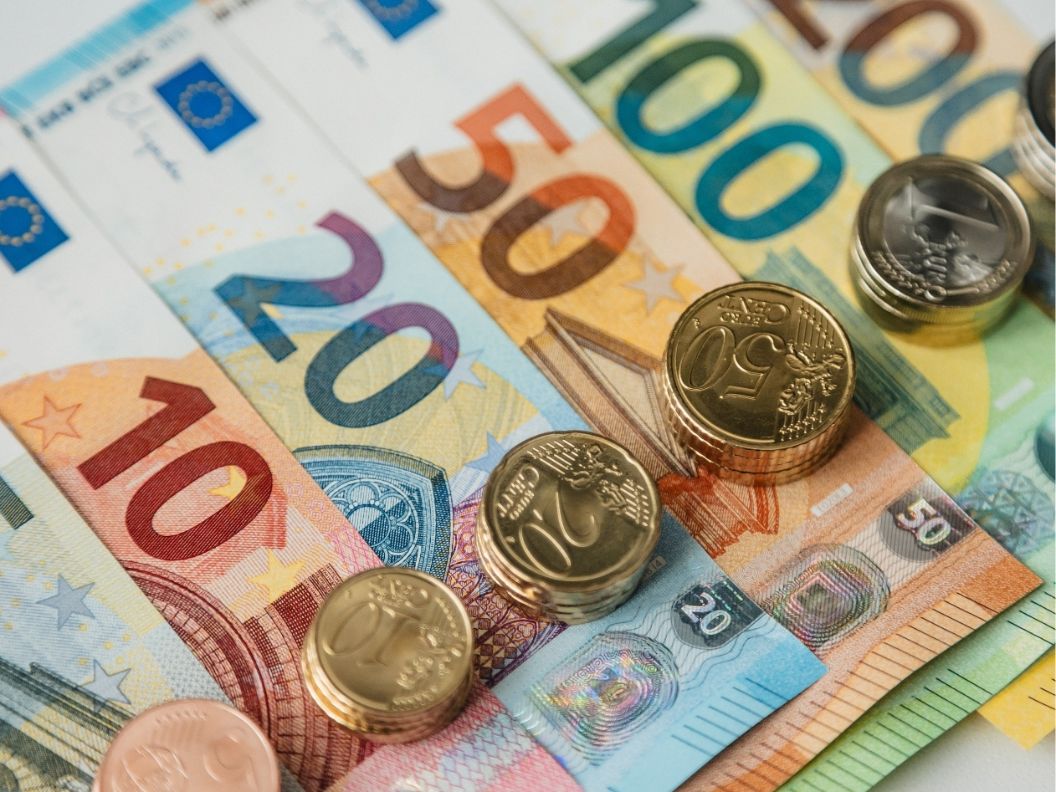
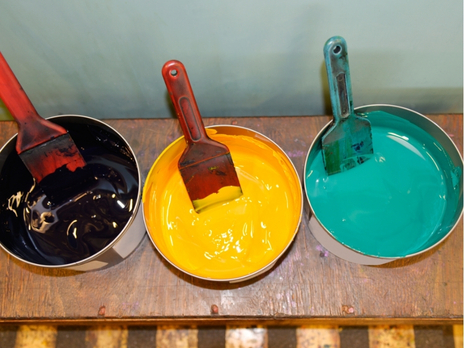
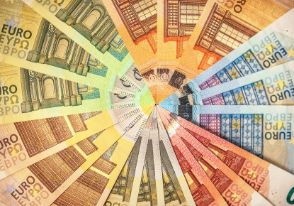
Each denomination of euro banknotes has its own colour and size. This not only makes it easier to tell them apart in everyday life. It also gives each denomination its own identity. The colours were deliberately chosen to be friendly and inviting in order to convey a sense of trust and familiarity.
European symbols
All euro banknotes feature elements that represent the European spirit:
- the EU flag, with its twelve stars symbolising unity and harmony
- the signature of the President of the ECB, which demonstrates institutional accountability
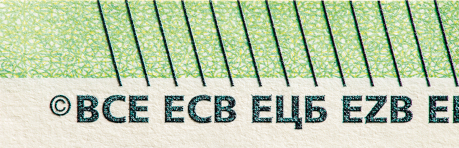
- the name “euro” in various alphabets (Latin, Greek, Cyrillic) as a symbol of linguistic and cultural diversity
- the map of Europe, which illustrates our geographical ties
Symbols of security
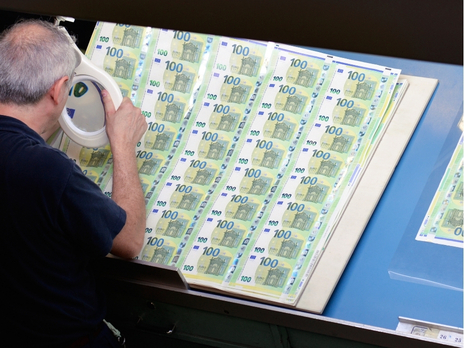
The security features of our euro banknotes – watermarks, holograms and security threads – also have a symbolic dimension. They symbolise stability, trust, and the reliability of the single currency. For a strong currency, economic credibility is not enough. It must also have visual credibility.
The Governing Council of the ECB decided not to include a EUR 500 banknote in the second series of euro banknotes, the Europa series. EUR 500 banknotes of the first series continue to be legal tender. They are no longer issued by central banks, but commercial banks can dispense old EUR 500 banknotes while stocks last.
Please note: If you still have EUR 500 banknotes, you can pay with them in shops, deposit them in your bank account or exchange them for banknotes of the Europa series at the OeNB.
Euro banknotes of the Europa series
5 Euro: Baustil Klassik | Farbe Grau | Größe: 120 x 62 x 0,12 mm | Gewicht: 0,6 g
10 Euro: Baustil Romanik | Farbe Rot | Größe: 127 x 67 x 0,12 mm | Gewicht: 0,7 g
20 Euro: Baustil Gotik | Farbe Blau | Größe: 133 x 72 x 0,12 mm | Gewicht: 0,8 g
50 Euro: Baustil Renaissance | Farbe Orange | Größe: 140 x 77 x 0,12 mm | Gewicht: 0,9 g
100 Euro: Baustil Barock und Rokoko | Farbe Grün | Größe: Europa-Serie 147 x 77 x 0,12 mm; Erste Serie 147 x 82 x 0,12 mm | Gewicht: 1,0 g
200 Euro: Baustil Eisen- und Glasarchitektur des 19. Jahrhunderts | Farbe Gelblich-braun | Größe: 153 x 77 x 0,12 mm | Gewicht: 1,1 g
Euro banknotes of the first series
Related links
- Video: euro banknotes – made to last
- ECB: Images and reproduction rules You are free to use images of euro banknotes without prior authorisation as long as you comply with the ECB’s rules on the reproduction of banknotes
- ECB: The environmental footprint of euro banknotes What is the environmental footprint of paying with euro banknotes?
- Online survey on the quality of euro banknotes in circulation Your feedback is essential to help us to ensure that the euro banknotes are of the best possible quality
Feel
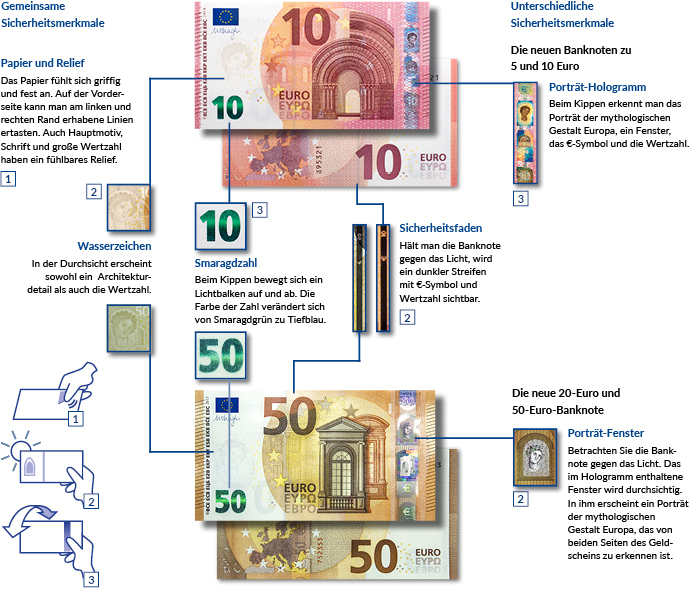
Banknote paper and raised print: Feel the banknote. The paper is crisp and firm. On the front, you can feel raised lines along the left and right edges. The main image, the lettering and the large value numeral also feel thicker.
Look
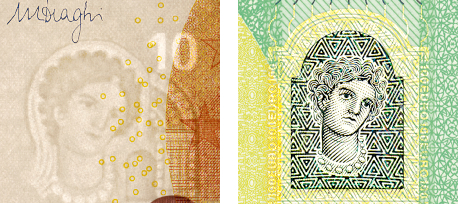
Portrait watermark: Hold the banknote against the light. You can see a portrait of Europa, a window and the value numeral.
Security thread: Hold the banknote against the light. You can see the security thread as a dark line. The euro symbol and the value of the banknote can be seen in tiny lettering in that line.
Portrait window (only on EUR 20, EUR 50, EUR 100 and EUR 200 banknotes): Hold the banknote against the light. The window in the hologram becomes transparent. It shows a portrait of Europa on both sides of the banknote.
Tilt
Portrait hologram (only on EUR 5 and EUR 10 banknotes): Tilt the banknote. You can see a portrait of Europa, a window, the euro symbol and the value numeral.
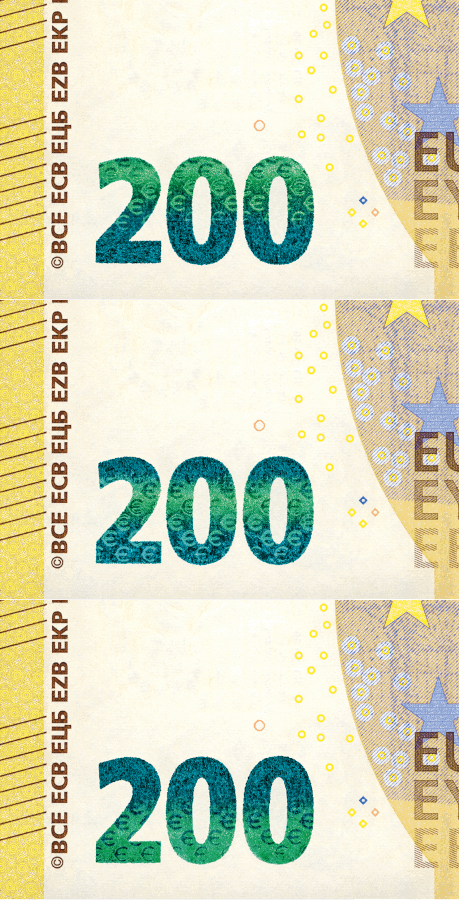
Emerald number: Tilt the banknote. A light effect moves up and down the emerald number. The colour of the number changes from emerald green to deep blue. On the EUR 100 and EUR 200 banknotes, you can see additional euro symbols.
Satellite hologram (only on EUR 100 and EUR 200 banknotes): Tilt the banknote. You can see euro symbols move around the value numeral at the top of the silvery stripe. The euro symbols become clearer under direct light.
Overview of all security features
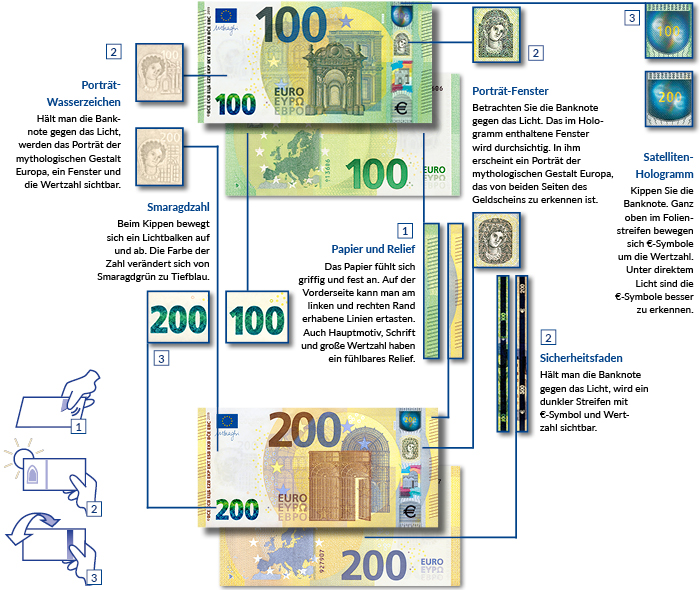
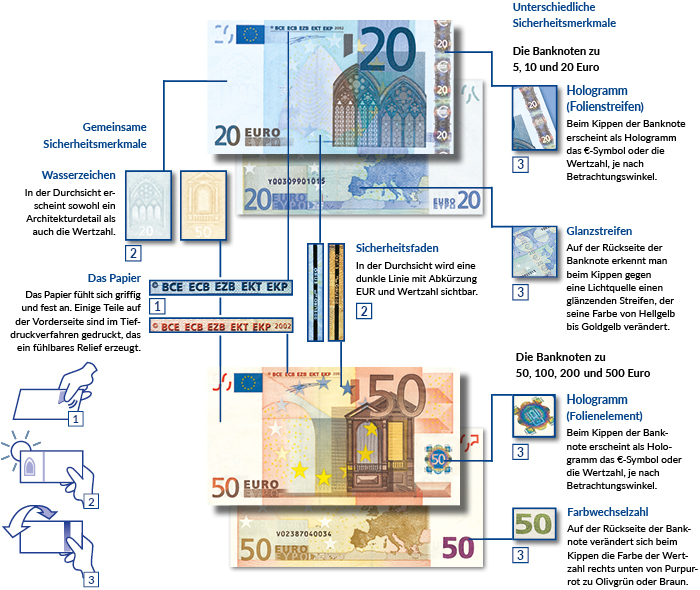
The security features of the EUR 100 banknote
- Never rely on just one security feature.
- Always check several security features to make sure that a banknote is genuine.
You may also be interested in
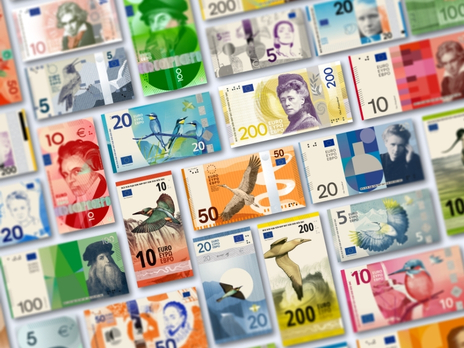
The third series of euro banknotes
The European Central Bank is currently working on the third series of euro banknotes. The redesign process aims to make euro banknotes more modern, more secure and more sophisticated in terms of banknote technology. This is to ensure that euro cash remains counterfeit-proof, sustainable and relatable to all Europeans.
Why do we need a third banknote series?
he ECB regularly redesigns our euro banknotes in order to
- modernise their security features
- improve protection against counterfeiting
- make use of more sustainable materials and production processes
- make banknote design more inclusive (e.g. to ensure that people with visual impairments can distinguish banknotes more easily)
- to help people identify more easily with the euro
Themes and motifs
The Governing Council of the ECB has identified two possible themes for the new series: "European culture" and "Rivers and birds". This decision is based on two surveys carried out in the summer of 2023 across Europe. People were asked to choose their favourites from seven proposed themes. The two themes identified will serve as the basis for the design phase.
Milestones in the redesign process
- 2021: ECB starts redesign process
- 2023: Europe-wide surveys identify most popular themes
- 2025/2026: design competition among selected EU designers
- 2026: ECB Governing Council is expected to decide on final design, production and time schedule
It will be some time yet before the new banknotes actually enter circulation. Once the design has been finalised, there will be extensive technical testing, production preparations and security checks.
Design proposals
Related links
- OeNB press release (German): EZB präsentiert Endauswahl der Designs für die neuen Banknoten
- ECB: Future banknotes
- EZB: Design-Entwürfe im Detail ECB: Future euro banknote design proposals
Latest on cash



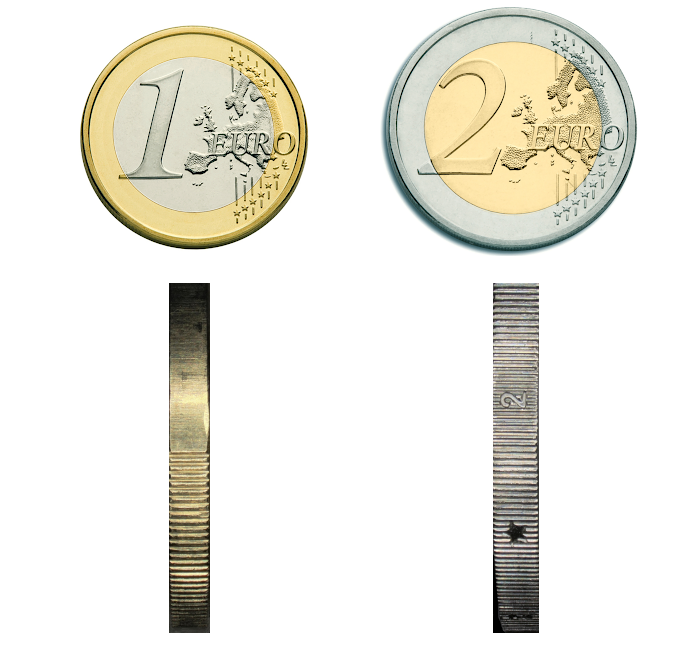
On the EUR 1 and EUR 2 coins minted between 1999 and 2007, EU member states are depicted as an integral whole to emphasise European unity. The new design of the EUR 1 and EUR 2 coins shows a geographical image of Europe.
Key features
- A special bimetal technology is used to produce EUR 1 and EUR 2 coins.
- Because of their specific metal composition, the EUR 1 and EUR 2 coins have particular magnetic properties that make them safer to use in vending machines.
- The edge of the EUR 1 coin has an interrupted milled pattern. The edge of the EUR 2 coin features edge lettering and a fine milled pattern.
Accessibility
- The face values on the common side are clearly visible and easily discernible by touch.
- The coins differ significantly in size.
- The coins are two-coloured.
- The coins’ edges have different milling patterns.
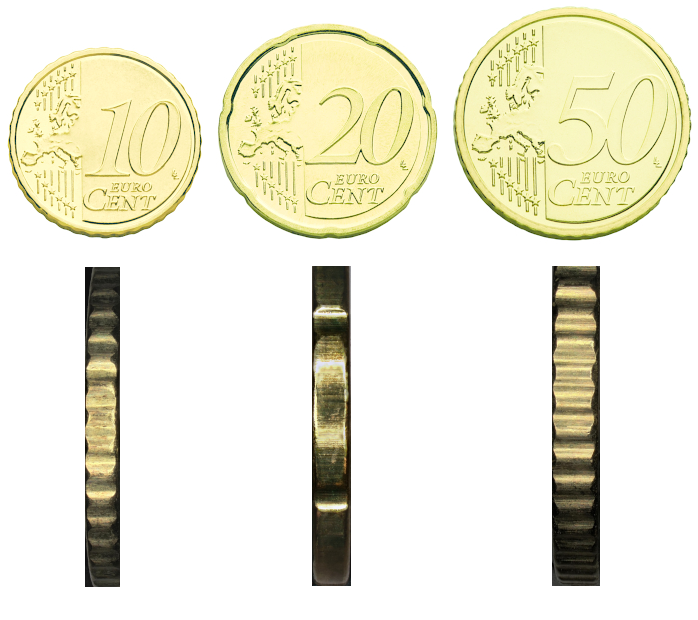
On the 10 cent, 20 cent and 50 cent coins minted between 1999 and 2007, the European Union is depicted as a group of individual states. The new design of these coins shows a geographical image of Europe.
Key features
- The 10 cent, 20 cent and 50 cent coins are made of nordic gold, a unique alloy which is difficult to melt and is used exclusively for coins.
- The 10 cent and 50 cent coins have shaped edges with fine scallops. The edge of the 20 cent coin is smooth and features a distinctive design with seven indentations, known as the “Spanish flower”.
Accessibility
- The face values on the common side are clearly visible and easily discernible by touch.
- The coins differ significantly in size.
- The edges of coins of consecutive face values have different milling patterns.
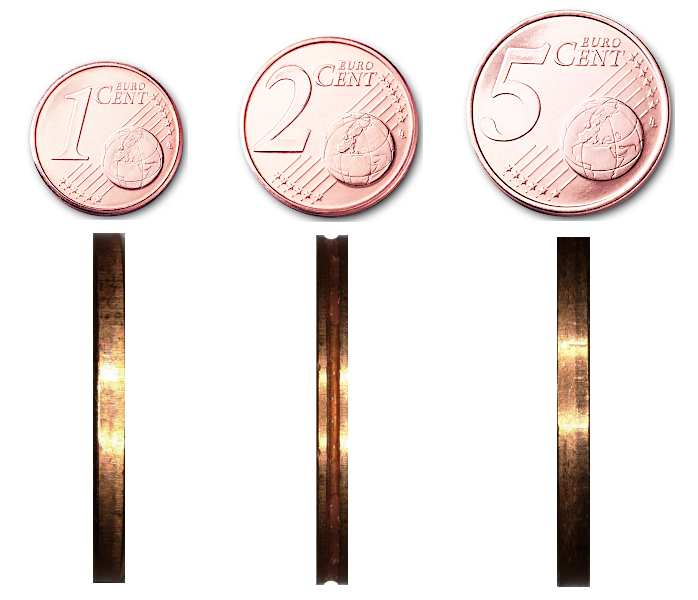
The common design on the 1 cent, 2 cent and 5 coins shows Europe in relation to the world.
Key features
- The coins are made of iron/steel on the inside and are coated with a thin layer of copper on the outside.
- Because of their steel core, these coins are highly magnetic.
- The edges of the 1 cent, 2 cent and 5 cent coins are smooth. The 2 cent coin has a groove running round its edge to make it easier to distinguish it from the 1 cent and 5 cent coins.
Accessibility
- The face values on the common side are clearly visible and easily discernible by touch.
- The coins differ significantly in size.
- The edges of coins of consecutive face values have different milling patterns.
Austrian EUR 2 commemorative coins
Weiterführende Infos
You may also be interested in
The serial numbers of euro banknotes start with a letter. For the first series of euro banknotes, this letter is a country code. It shows which national central bank of the euro area commissioned the printing of a banknote. The country codes are listed below.
| Belgium | Z |
| Greece | Y |
| Germany | X |
| Spain | V |
| France | U |
| Ireland | T |
| Italy | S |
| Croatia | *) |
| Luxembourg | *) |
| Netherlands | P |
| Austria | N |
| Portugal | M |
| Finland | L |
| Slovenia | H |
| Cyperus | G |
| Malta | F |
| Slowakia | E |
| Estonia | D |
| Latvia | C |
*) New euro banknotes issued by the Croatian National Bank and the Banque centrale du Luxembourg bear the codes of the national central banks of the countries where the banknotes for Croatia and Luxembourg were produced.
The serial numbers of euro banknotes of the Europa series consist of two letters and ten digits. The first letter identifies the printing works that produced a banknote, not the issuing central bank. The second letter can be used by printing works to make more serial numbers possible. Printing works and corresponding letters are listed below.
| Nationale Bank van België/Banque Nationale de Belgique | Z |
| Bank of Greece | Y |
| Giesecke & Devrient GmbH (Munich) | X |
| Giesecke & Devrient GmbH (Leipzig) | W |
| Fábrica Nacional de Moneda y Timbre | V |
| Banque de France | U |
| Banc Ceannais na hÉireann/Central Bank of Ireland | T |
| Banca d'Italia | S |
| Bundesdruckerei GmbH | R |
| Joh. Enschede Security Printing BV | P |
| Oesterreichische Banknoten und Sicherheitsdruck GmbH | N |
| Valora | M |
| Not assigned | L |
| Not assigned | K |
| De La Rue Currency (Gateshead) | J |
| De La Rue Currency (Loughton) | H |
| Not assigned | G |
| Oberthur Fiduciaire AD (Sofia) | F |
| Oberthur Fiduciaire SAS (Chantepie) | E |
| Polska Wytwórnia Papierów Wartościowych | D |
| Not assigned | C |
| Not assigned | B |
| Not assigned | A |
No. The bridges and parts of buildings depicted on the euro banknotes do not exist. They were designed to represent different ages and styles and do not depict any specific structures, such a not to be associated with a particular country. Their meaning is purely symbolic. Similar bridges, windows and doorways can be found in many parts of Europe.
The decision not to produce EUR 1 or EUR 2 banknotes had to do with harmonising different standards in place across the EU at the time the euro was introduced. Furthermore, from a business perspective, coins are preferable for small denominations, as they have a longer lifespan.
Each denomination is a different size to make it easier for blind and visually impaired people to tell them apart.
The TRY 1 coin looks a lot like the EUR 2 coin. There are a number of obvious differences, however:
- the value number – “1” vs “2”
- the design of the edges – the edge of the TRY 1 coin is milled, while there is lettering and fine milling around the edge of the EUR 2 coin
- the material composition – the TRY 1 exhibits different electrical properties and it is not magnetic
There are similarities in the two-colour, bimetal design as well as in the dimensions and weights of the coins.
As other bimetal coins existed even before the euro was introduced, the TRY 1 coin bears a resemblance to coins of other currencies as well.
The sorting machines operated by the OeNB and its subsidiaries are able to identify lira coins without any difficulty.
The TRY 1 coin is worth around EUR 0.47 (subject to current exchange rates). To avoid any inconvenience, please make sure to check coins carefully before accepting them.
There are currency agreements in place that allow these countries to issue their own euro coins.
No, this is not necessary. Even if they have different national sides, euro circulation coins are legal tender throughout the euro area.
Yes. All euro banknotes and coins meet the same high quality standards, even if they have been – and continue to be – produced by different printing works and mints throughout the euro area. A carefully designed quality management system sees to that.
Specific precautions have been taken to prevent the counterfeiting of euro coins, especially those of high denominations (EUR 1 and EUR 2). The sophisticated two-colour design of the EUR 1 and EUR 2 coins, the embossed lettering around the edge of the EUR 2 coin and the milled edges of all other euro coins make them considerably difficult to counterfeit. The special alloys they are made of are extremely difficult to replicate. Moreover, the centre pieces of the EUR 1 and EUR 2 coins are made of a three-layer material with a magnetisable core. This makes it easier for vending machines to verify their authenticity.
The OeNB does not trade in foreign currency.
- You can exchange Austrian schillings (and groschen) for euro (and cent) at the OeNB in Vienna and at OeNB – Western Austria in Innsbruck. No deadline applies for Austrian schillings of the last series.
- Other legacy currencies of the euro, like Deutsche mark, can only be exchanged at the national central banks of the respective country.
- When the euro is introduced in further EU countries, the OeNB will offer a currency exchange service for a period of two months from the date of introduction for those foreign currencies that are being replaced by the euro.
- You can also send legacy currencies to the relevant central bank by insured mail, provided you include you bank details for the refund. Please note that different deadlines may apply for exchanging old banknotes or coins for euro.
