Interest rates
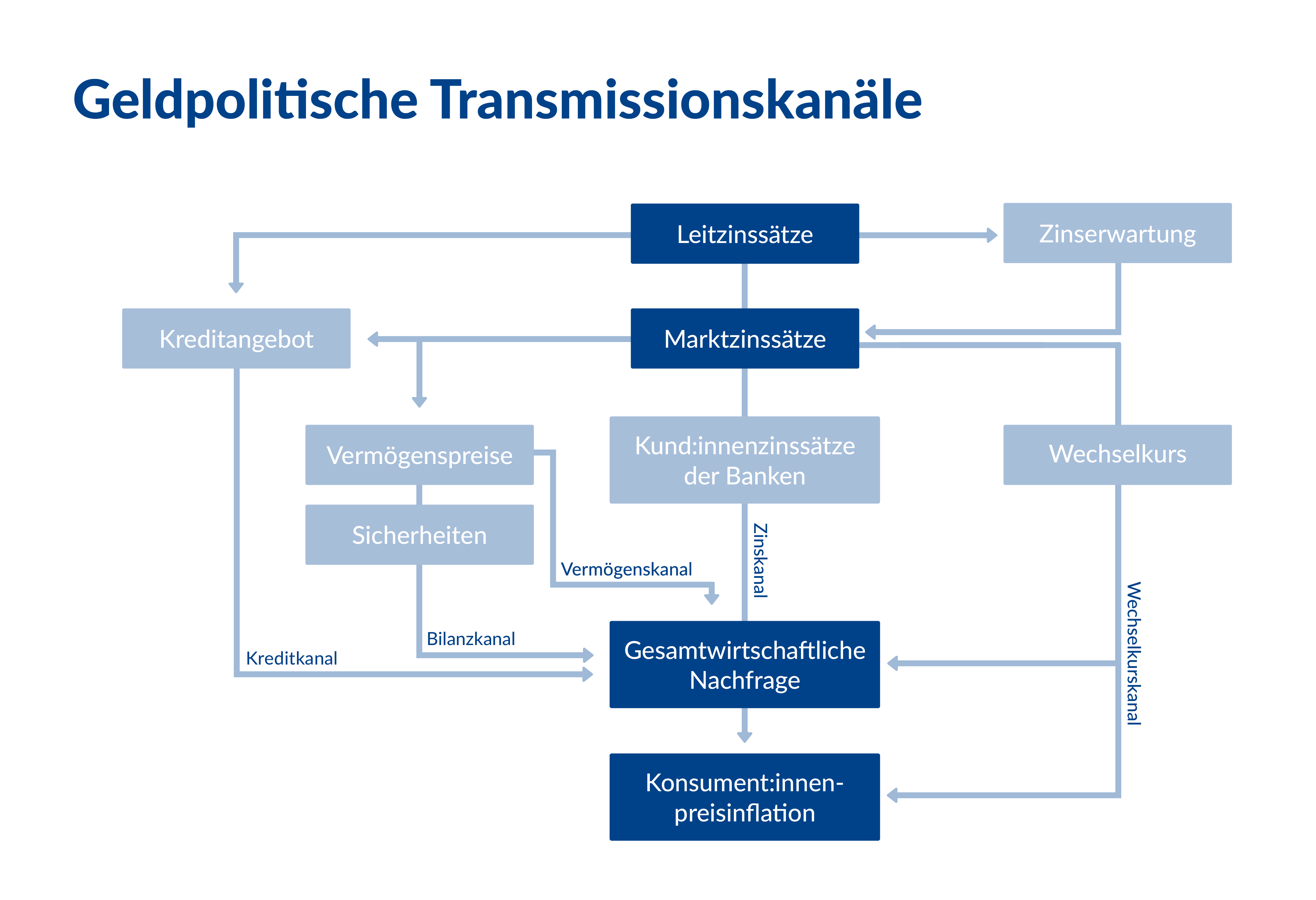
Interest rates tell us how much it costs to borrow money or how much we can earn by investing money. They are the most important monetary policy instrument to influence prices. When central banks change their key interest rates, this also affects interest rates on savings and loans.

-
Current key interest rates
as of: 16/09/26

Through this channel, an increase in key interest rates triggers higher short-term market interest rates. If key interest rates are expected to remain higher over a longer term, longer-term market interest rates will also rise. When inflation expectations are stable, a rise in the key interest rate leads to an increase in the real interest rate – that is, the real cost of capital for businesses. This cost increase also applies to banks; they, too, will then raise funds at a higher interest rate and pass this increased cost on to their customers. If the cost of borrowing rises, the investment activity by businesses and households declines. Furthermore, as a result of higher interest rates, households will save more and consume less. As a result, there is a reduction in demand.
If the demand for goods and services falls below supply, this ultimately puts downward pressure on consumer prices. Furthermore, lower consumer and investment demand may lead to lower demand in the labour and intermediate goods markets. This, in turn, dampens price and wage growth in those markets.
On the whole, the rise in prices (= inflation) is therefore less pronounced as a result of an increase in key interest rates.
Interest rate policy also works the other way round. A cut in key interest rates stimulates demand and, consequently, GDP growth, which will drive up inflation.
An increase in key interest rates also has an impact on exchange rates. If domestic interest rates rise, investments in the local currency become more attractive – compared with investments in foreign currencies. Consequently, capital will flow into the country’s own currency area and the domestic currency will appreciate.
As a result of this appreciation, imported goods become cheaper. In other words, they will become more attractive compared to domestic goods. This will lead to lower demand for domestically produced goods and, consequently, a reduction in overall economic output.
If the demand for goods and services falls below supply, this ultimately puts downward pressure on consumer prices. Furthermore, lower consumer and investment demand may lead to lower demand in the labour and intermediate goods markets. This, in turn, dampens price and wage growth in those markets.
On the whole, the rise in prices (= inflation) will therefore be less pronounced as a result of an increase in key interest rates.
In addition, the exchange rate channel has a direct impact on inflation. An appreciation of the domestic currency means that imported goods become cheaper. As these goods are also included in our basket of goods, this has a direct dampening effect on inflation.
The more open an economy is to other economies, the stronger the impact of the exchange rate channel.
Monetary policy signals are also transmitted through asset prices, such as share prices and property prices. A rise in key interest rates (restrictive monetary policy) makes newly issued bonds appear more attractive than shares, as they promise a higher yield following the key interest rate rise. This reduces the demand for shares, which in turn dampens share prices. Furthermore, an interest rate increase drives up the cost of mortgage financing and thus reduces both the demand for and the prices of real estate.
Lower share prices and property prices will then cause household wealth to decline. This leads to a reduction in household resources. This, in turn, will lead to lower growth in consumption and, consequently, subdued aggregate demand.
Lower share prices also increase a company’s cost of capital, as the company will receive less per share. This leads to lower corporate investment and, consequently, to lower demand.
As with the channels mentioned earlier, lower demand dampens inflation.
Changes in the prices of property, shares and other assets affect not only the resources available to households and businesses (see wealth channel), but also their ability to borrow: If asset prices fall, the value of the collateral available to them for securing loans also falls. This, in turn, leads to lower borrowing or higher borrowing costs, lower investment and consumer spending, and consequently subdued aggregate demand, which in turn acts as a brake on inflation.
Changes in key interest rates affect the supply of credit. If key interest rates are raised, it becomes more expensive for banks to borrow money themselves, because:
- money market interest rates will rise;
- banks will have to pay higher interest rates on deposits from households and businesses (higher interest rates on savings);
- interest rates on newly issued bonds will rise and
- banks’ balance sheet positions will deteriorate (see balance sheet channel).
If it is more difficult (more expensive) for commercial banks to refinance themselves, they will also find it harder to grant new loans. Consequently, the supply of credit will decline. Furthermore, when interest rates rise, there is an increased risk that loans will not be repaid as agreed. This is another reason why banks become more cautious about granting loans when interest rates are rising. In both cases, households and businesses – particularly those classified as high-risk – are forced to postpone their consumer spending or investment plans.
As with the channels mentioned earlier, lower demand dampens inflation.
externes Angebot

| für die Verzugszinsenberechnung im Unternehmergeschäft für Verträge, die ab dem 16.3.2013 geschlossen wurden (§456 UGB in Kraft seit dem 16.3.2013 gemäß BGBl I Nr. 50/2013: | |
|---|---|
| Basiszinssatz am 1. Juli 2026 | 1,53 % |
| Basiszinssatz am 1. Jänner 2026 | 1,53 % |
| Basiszinssatz am 1. Juli 2025 | 1,53 % |
| Basiszinssatz am 1. Jänner 2025 | 2,53 % |
| Basiszinssatz am 1. Juli 2024 | 3,88 % |
| Basiszinssatz am 1. Jänner 2024 | 3,88 % |
| Basiszinssatz am 1. Juli 2023 | 3,38 % |
| Basiszinssatz am 1. Jänner 2023 | 1,88 % |
| Basiszinssatz am 1. Juli 2022 | −0,62 % |
| Basiszinssatz am 1. Jänner 2022 | −0,62 % |
| Basiszinssatz am 1. Juli 2021 | −0,62 % |
| Basiszinssatz am 1. Jänner 2021 | −0,62 % |
| Basiszinssatz am 1. Juli 2020 | −0,62 % |
| Basiszinssatz am 1. Jänner 2020 | −0,62 % |
| Basiszinssatz am 1. Juli 2019 | −0,62 % |
| Basiszinssatz am 1. Jänner 2019 | −0,62 % |
| Basiszinssatz am 1. Juli 2018 | −0,62 % |
| Basiszinssatz am 1. Jänner 2018 | −0,62 % |
| Basiszinssatz am 1. Juli 2017 | −0,62 % |
| Basiszinssatz am 1. Jänner 2017 | −0,62 % |
| Basiszinssatz am 1. Juli 2016 | −0,62 % |
| Basiszinssatz am 1. Jänner 2016 | −0,12 % |
| Basiszinssatz am 1. Juli 2015 | −0,12 % |
| Basiszinssatz am 1. Jänner 2015 | −0,12 % |
| Basiszinssatz am 1. Juli 2014 | −0.12 % |
| Basiszinssatz am 1. Jänner 2014 | −0,12 % |
| Basiszinssatz am 1. Juli 2013 | −0,12 % |
| Basiszinssatz am 1. Jänner 2013 | 0,38 % |
| für die Verzugszinsenberechnung im Unternehmergeschäft für Verträge, die vor dem 16.3.2013 geschlossen wurden: | |
|---|---|
| Basiszinssatz am 30. Juni 2026 | 1,53 % |
| Basiszinssatz am 31. Dezember 2025 | 1,53 % |
| Basiszinssatz am 30. Juni 2025 | 1,53 % |
| Basiszinssatz am 31. Dezember 2024 | 2,53 % |
| Basiszinssatz am 30. Juni 2024 | 3,88 % |
| Basiszinssatz am 31. Dezember 2023 | 3,88 % |
| Basiszinssatz am 30. Juni 2023 | 3,38 % |
| Basiszinssatz am 31. Dezember 2022 | 1,88 % |
| Basiszinssatz am 30. Juni 2022 | −0,62 % |
| Basiszinssatz am 31. Dezember 2021 | −0,62 % |
| Basiszinssatz am 30. Juni 2021 | −0,62 % |
| Basiszinssatz am 31. Dezember 2020 | −0,62 % |
| Basiszinssatz am 30. Juni 2020 | −0,62 % |
| Basiszinssatz am 31. Dezember 2019 | −0,62 % |
| Basiszinssatz am 30. Juni 2019 | −0,62 % |
| Basiszinssatz am 31. Dezember 2018 | −0,62 % |
| Basiszinssatz am 30. Juni 2018 | −0,62 % |
| Basiszinssatz am 31. Dezember 2017 | −0,62 % |
| Basiszinssatz am 30. Juni 2017 | −0,62 % |
| Basiszinssatz am 31. Dezember 2016 | −0,62 % |
| Basiszinssatz am 30. Juni 2016 | −0,62 % |
| Basiszinssatz am 31. Dezember 2015 | −0,12 % |
| Basiszinssatz am 30. Juni 2015 | −0,12 % |
| Basiszinssatz am 31. Dezember 2014 | −0,12 % |
| Basiszinssatz am 30. Juni 2014 | −0,12 % |
| Basiszinssatz am 31. Dezember 2013 | −0,12 % |
| Basiszinssatz am 30. Juni 2013 | −0,12 % |
| Basiszinssatz am 31. Dezember 2012 | 0,38 % |
| Basiszinssatz am 30. Juni 2012 | 0,38 % |
| Basiszinssatz am 31. Dezember 2011 | 0,38 % |
| Basiszinssatz am 30. Juni 2011 | 0,38 % |
| Basiszinssatz am 31. Dezember 2010 | 0,38 % |
| Basiszinssatz am 30. Juni 2010 | 0,38 % |
| Basiszinssatz am 31. Dezember 2009 | 0,38 % |
| Basiszinssatz am 30. Juni 2009 | 0,38 % |
| Basiszinssatz am 31. Dezember 2008 | 1,88 % |
| Basiszinssatz am 30. Juni 2008 | 3,19 % |
| Basiszinssatz am 31. Dezember 2007 | 3,19 % |
| Basiszinssatz am 30. Juni 2007 | 3,19 % |
| Basiszinssatz am 31. Dezember 2006 | 2,67 % |
| Basiszinssatz am 30. Juni 2006 | 1,97 % |
| Basiszinssatz am 31. Dezember 2005 | 1,47 % |
| Basiszinssatz am 30. Juni 2005 | 1,47 % |
| Basiszinssatz am 31. Dezember 2004 | 1,47 % |
| Basiszinssatz am 30. Juni 2004 | 1,47 % |
| Basiszinssatz am 31. Dezember 2003 | 1,47 % |
| Basiszinssatz am 30. Juni 2003 | 1,47 % |
| Basiszinssatz am 31. Dezember 2002 | 2,20 % |
| Basiszinssatz am 30. Juni 2002 | 2,75 % |