Central, Eastern and Southeastern Europe

Austria has strong economic ties with Central, Eastern and Southeastern Europe (CESEE). That is why we have been keeping an eye on developments in this region for many years. Our analyses and cross-country comparisons provide important insights for policymakers, businesses and researchers.

Why the CESEE region is important

The Austrian economy, particularly the banking sector, is closely linked to the economies of Central, Eastern and Southeastern Europe (CESEE). Our CESEE team at the OeNB carries out targeted research into economic developments in these countries. In this way, we aim to contribute to a better understanding of European integration.

Our objectives and focus countries

In our CESEE analyses, we examine 18 economies: Albania, Bosnia and Herzegovina, Bulgaria, Croatia, Czechia, Hungary, Kosovo, Moldova, Montenegro, North Macedonia, Poland, Romania, Russia, Serbia, Slovakia, Slovenia, Türkiye and Ukraine.

We continuously monitor and analyse Europe’s economic integration, as well as macroeconomic and financial developments in individual CESEE countries. This helps us make meaningful cross-country comparisons and, in turn, assess the implications for the Austrian economy and financial stability.

Focus areas

Our research focuses on key topics that are crucial for monetary policy and financial stability given the economic ties between the CESEE region and the euro area. These topics include:

  • use of the euro
  • real estate markets
  • economic activity 

The Euro Survey – a valuable source of data

With the OeNB Euro Survey, we conduct an annual international survey of private individuals in CESEE to find out more about the use of the euro in the region. Over the years, we have been able to build up a valuable dataset, which is widely used in international research.

Euro Survey

Our research findings

We share the results of our work with the research community and the general public via various channels and formats, including these regular OeNB Reports:

  • Economic trends in CESEE EU member states
  • Economic trends in EU candidates and Russia
  • CESEE Property Market Review
  • OeNB Euro Survey in Central, Eastern and Southeastern Europe
OeNB Reports on CESEE

Current OeNB Reports

Events

We organise regular events and work with a wide range of partners to exchange information on CESEE issues relevant to economic policy and to support economic development. Annual highlights include:

  • Conference on European Economic Integration
  • East Jour Fixe
Past events

We work with international partners

The OeNB regularly cooperates with many central banks, institutions and research organisations across CESEE. Key partners include the Bank of Finland Institute for Emerging Economies, the Joint Vienna Institute and numerous central banks across the region.

Training and consulting for central banks – the Joint Vienna Institute

We offer training and advice to central banks in Central, Eastern and Southeastern Europe, as well as in Central Asia and the Caucasus. Our objective is to support countries in the above-mentioned regions in the further development of their economic systems.

A key pillar of this technical cooperation is the OeNB’s involvement at the Joint Vienna Institute (JVI), a training institute founded in 1992. The OeNB provides funding for the institute, together with Austria’s Federal Ministry of Finance and the International Monetary Fund. In addition, the OeNB holds courses and workshops at the JVI, sharing its expertise on central bank-related topics. The aim of these courses is not only to impart knowledge, but also to provide an international forum for the exchange of views and experiences, and to help course participants build strong lasting networks.

Together with other central banks in the European System of Central Banks, the OeNB participates in EU-funded programmes, particularly those aimed at EU candidates and potential candidates in the Western Balkans.

Research network and long-standing partner organisations

We have longstanding research cooperation partners, i.e. central banks and selected research institutes. With these partners, we conduct regular exchanges through bilateral research visits, joint events and research cooperation. 

Further, we have created a research network (CESEE.net) for economists at central banks within the ESCB and in countries that are considered EU candidates. CESEE.net is hosted by the OeNB together with the central banks of Latvia, Slovakia and Czechia. The aim is to exchange information on topics relevant to economic policy, with a regional focus on Central, Eastern and Southeastern Europe.

SEEMHN: South-East European Monetary History Network

The South-East European Monetary History Network (SEEMHN) brings together financial and monetary historians, economists and statisticians. It was established in April 2006 upon the initiative of the Bulgarian National Bank and the Bank of Greece. Its main objective is to promote knowledge of Southeastern European monetary history and policy as an integral part of European history. Against this backdrop, the network publishes studies and organises conferences that focus on the study of specific phenomena and events connected with Southeastern European countries, both from a historical and a comparative perspective. The central banks of the following countries are currently members of the SEEMHN: Albania, Austria, Bulgaria, Greece, Hungary, Romania, Serbia and Türkiye.

SEEMHN data volume: a unique historical time series database for Southeastern Europe

Recognising the need for reliable data as a basis for empirical studies, several central banks decided to establish a database of 19th and 20th century monetary and financial data for Southeastern Europe in 2006. Since then, the central banks of Albania, Austria, Bulgaria, Greece, Romania, Serbia and Türkiye have been working on this project together. The resulting data volume represents a milestone in the joint endeavour to publish harmonised long-run time series on monetary, financial and other macroeconomic variables.

Details of the SEEMHN dataset

A complete dataset is presented for each country, covering six broad groups of indicators: (1) monetary variables, (2) interest rates, (3) exchange rates, (4) government finances, (5) prices, production and labour and (6) national accounts and population.

Each chapter consists of four parts: (1) major monetary events, including a short account of the respective country’s institutional framework for monetary policy implementation; (2) a detailed description and definition of the published variables; (3) a detailed discussion of the primary and secondary data sources used in the data collection process; and (4) the historical data series per country.

At the beginning of each country chapter, an index table provides information on the list of variables presented, the time span covered, the reporting frequency, the applicable unit of account and the codes assigned to the variables. The reader can use the index table as a roadmap for safe data search. It is replicated in each country data file. This makes it easier to quickly navigate to the required time series on a monthly or annual basis.

South-Eastern European Monetary and Economic Statistics from the Nineteenth Century to World War II, published by: Bank of Greece, Bulgarian National Bank, National Bank of Romania, Oesterreichische Nationalbank, 2014, Athens, Sofia, Bucharest, Vienna.

© Bank of Greece, Bulgarian National Bank, National Bank of Romania, Oesterreichische Nationalbank, 2014. All rights reserved. May be reproduced for noncommercial, educational and scientific purposes provided that the source is acknowledged.

Why we need good CESEE data

As a central bank, we are interested in the international role of the euro. Specifically, we provide the only data source that contains information on the use of the euro in Central, Eastern and Southeastern Europe (CESEE) and answers the following questions:

  • To what extent is the euro used in the various CESEE countries? 
  • In how far do people in the region trust the euro and central banks? 
  • Do people in the region save in euro or in their local currencies? 
  • What are their inflation expectations? 
  • How do they make financial decisions?

Through data collection and analysis, we provide answers to these and many other questions. This is important for research, policymakers and businesses – because good decisions require a sound data foundation.

OeNB Euro Survey

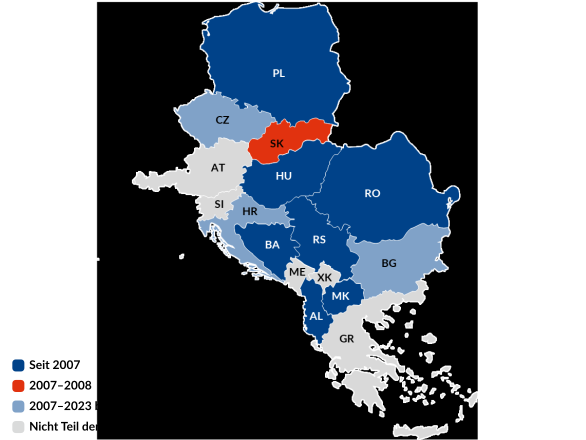
The OeNB Euro Survey is an international survey and a cornerstone of our strategic focus on CESEE. Since 2007, we have been conducting this annual survey of private individuals in Central, Eastern and Southeastern Europe (CESEE) on the use of the euro in the region. Over the years, we have been able to build up a valuable dataset, which is used in international research. 

The key topics examined are:

  • use of the euro (euroisation)
  • trust in institutions
  • financial stability
  • monetary expectations
  • financial decisions

Essentially, we are examining those countries that have not yet (or have only recently) adopted the euro. The data collected through the OeNB Euro Survey provide insights into why and how frequently people in the region use foreign currencies (mainly the euro). We share the collected data with the central banks in CESEE and the euro area, other policymakers and supervisory authorities, and the research community.

A unique data source 

The OeNB Euro Survey forms an integral part of the OeNB’s CESEE research agenda and financial stability analysis. This unique, scientifically sound data source enables us to analyse how and to what extent European integration is affecting the lives of people in the CESEE region. It gives us insights into their views on economic and fiscal policy issues (such as the introduction of the euro). It also gives us a better understanding of the differences between and within the countries under study. The OeNB Euro Survey is conducted by the Austrian Gallup Institute on behalf of the OeNB, with the fieldwork being carried out by its local partner organisations.

How often are the data collected?

The OeNB Euro Survey is conducted at least once a year, using national versions of a standardised questionnaire for all countries covered by the survey. The key topics listed above form part of every survey round. Additional questions may be included to explore further topics. To date, questions have been added on the following topics (among others): 

  • inflation and inflation expectations
  • foreign-currency loans
  • excessive debt and loan arrears
  • non-bank loans and contingent liabilities 
  • government debt 

The economic and financial climate is constantly changing; sometimes crisis situations arise. Annual surveys make it possible for us to identify changes in saving and borrowing behaviour in a timely manner and to understand their impact on the use of the euro (euroisation). 

Are the data comparable?

To ensure that the data are as comparable as possible across countries, the national versions of the questionnaire and the survey methodology are harmonised before each survey wave. All national survey rounds are carried out among randomly selected adult citizens of the respective countries. Data are collected from individuals aged 18 and over. The minimum sample size per survey wave is 1,000 people per country. 

Main results

The OeNB Euro Survey is a unique source of comprehensive information on how people in Central, Eastern and Southeastern Europe use the euro. It provides insights into foreign-currency assets and liabilities held by private individuals in CESEE countries. The standardised structure of the survey across the entire region allows for comparisons not only between individual countries but also between different socio-demographic groups. The microdata from the OeNB Euro Survey provide valuable insights into the determinants of the use of the euro as a parallel currency (“euroisation”) and thus make an important contribution to the academic debate on this topic.

Detailed information on selected results from cross-country comparisons based on the OeNB Euro Survey can be found in our OeNB Reports and in our dashboard detailing the key findings of the OeNB Euro Survey.

Financial literacy in CESEE

Dashboard

The OeNB publishes comprehensive findings on financial literacy in Central, Eastern and Southeastern Europe via an interactive dashboard. While detailed data are available for a large number of countries, financial literacy remains an under-researched issue in many countries across the CESEE region. The data collected as part of the OeNB Euro Survey represent an important step towards closing this gap. The dashboard makes it possible to compare the situation in the CESEE countries with Austria and to create and download tailored charts, along with the underlying data.

Publications

Beckmann, E. and S. Reiter. 2020. How financially literate is CESEE? Insights from the OeNB Euro Survey. In: Focus on European Economic Integration, Q3/20. 36–59.

Beckmann, E. and S. Kiesl-Reiter. 2023. Financial literacy and financial wellbeing: Evidence from Eastern Europe in a high inflation environment. In: Journal of Financial Literacy and Wellbeing 1(2). 263–367.

Olbrich, L., E. Beckmann and J.W. Sakshaug. 2026. Multivariate assessment of interviewer errors in a cross-national economic survey and the role of fieldwork institutes. In: Journal of the Royal Statistical Society Series A: Statistics in Society, 189(1). 561–580. 

OeNB Financial Literacy Dashboard

Data usage

The data collected through the OeNB Euro Survey are made available free of charge for research purposes. The survey data are used in numerous OeNB publications; they also form the basis for successful cooperation projects, for example with: 

  • central banks
  • research institutions and universities 
  • World Bank
  • European Bank for Reconstruction and Development
  • CESifo
  • and other international organisations 

Research cooperation

We are happy to provide data for external research projects but are also open to research projects carried out jointly by OeNB economists and external researchers if they explore topics of mutual interest.

Who can use our data?

We are happy to share the data obtained from the OeNB Euro Survey with:

  • central banks
  • other decision-makers 
  • supervisory authorities 
  • research community

How can the data from the OeNB Euro Survey be used?

The use of OeNB Euro Survey data for external research projects is subject to certain conditions and follows a well-established procedure. There are two options:

Use of published data

If you wish to use results that have already been compiled by the OeNB and published on its website, you will find selected data from the OeNB Euro Survey under “Main results”. You can download graphs and underlying data as CSV files via the context menu of the respective charts.

Individual use of raw data

If you wish to make individual use of raw data from the OeNB Euro Survey for your research project, please follow these steps: 

1. To begin with, please read and sign the confidentiality agreement/terms of use. The terms of use list the specific conditions and restrictions under which the OeNB grants access to OeNB Euro Survey data.

2. In addition, you must submit a research outline. It must contain the following information:

  • the main research questions and motivation behind the planned research project for which you would like to use the requested OeNB Euro Survey data
  • a tentative time schedule for the research project and
  • the countries and survey waves you would like to use

3. Please send both documents to eurosurvey@oenb.at.

4. The OeNB will evaluate the submitted documents.

5. If the OeNB approves the research project, it will provide a download link to your dataset.

Questionnaire

The OeNB Euro Survey team is responsible for designing and continuously updating the questionnaire. This involves ensuring and improving data quality, optimising the survey process and linking the survey data with geographical information and other microdata. The OeNB survey team welcomes questions and feedback on the OeNB Euro Survey from other survey experts. Interested researchers are also invited to work with the OeNB Euro Survey team to develop new research topics and devise new questions. Research proposals submitted should address topics relevant to central banking.

Which topics does the questionnaire cover?

The questionnaire, which was compiled by our OeNB team, focuses on euroisation, i.e. the use of the euro outside the euro area. The main questionnaire includes questions on: 

  • use of foreign currencies 
  • preferences and determinants that influence the demand for foreign currency
  • financial crises and economic conditions 
  • expectations regarding exchange rates and inflation
  • income in foreign currency and financial literacy

Beyond euroisation, the questionnaire also covers areas that vary depending on when the survey is being conducted, such as access to credit, attitudes towards public debt and intentions to migrate. Socio-demographic data that are important for international comparisons have been harmonised ex ante since 2012. 

Background data describing the fieldwork process and the characteristics of the interviewers are collected in order to improve data quality. The translation into national languages and the programming of the questionnaire are subject to strict quality controls. Pilot testing and the programming process itself ensure the accuracy of the questionnaire and consistency across countries, with periodic adjustments made in response to feedback. Translation, programming and coding errors are monitored to ensure data integrity.

The technical guidance note for the questionnaire is available in English.

Methodology

The collection of data for the OeNB Euro Survey is carried out by polling organisations in the CESEE countries and coordinated centrally in Austria. The sample survey is carried out through face-to-face interviews, which are conducted either as computer-assisted personal interviews (CAPIs) or, much less frequently, as face-to-face interviews using pen and paper (PAPIs). In each wave of the survey, approximately 1,000 people per country (citizens of the country in question, aged 18 or over) are interviewed. The sample is selected using a multi-stage, stratified random sampling method with random route selection (random route sampling). Personal characteristics of the interviewers are also recorded, including gender, age, education, employment status and experience with the survey.

The monitoring of fieldwork involves checks for logical consistency, follow-up telephone calls and the verification of interviews through face-to-face visits. Post-stratification weights are used to correct for sampling effects. Data consistency checks and processing procedures include the verification of socio-demographic data, logical consistency checks and outlier detection. 

You can find detailed information in the download section.

CESEE banking sector database

We have set up our own database containing all bank branches and their locations across ten CESEE countries. This makes it possible for us to examine how the branch networks of banks in CESEE are developing. The CESEE banking sector database contains indicators for banking density, bank concentration and the role of foreign banks at the NUTS-3 level for ten CESEE countries.

Contact


Euro Survey