After a macroprudential measure has been implemented, the OeNB conducts ex post analyses to find out whether it had the intended effect. Therefore, the OeNB examines those indicators that have been used in the ex ante risk analysis and in setting the buffer. In addition, the analyses take into account other regulatory developments, macroeconomic changes and the assessments of international institutions (such as the ECB or the IMF) and rating agencies.
Impact assessment of macroprudential buffers
Ex ante impact assessments of capital-based macroprudential measures (i.e. capital buffers such as the O-SII buffer, the SyRB or the CCyB) follow a multi-stage process. In short, experts analyse how the “private costs” incurred by banks through the implementation of a macroprudential measure affect the pricing of loans. As a result, financing costs in the real economy may increase, which potentially dampens overall economic activity. These social – that is, macroeconomic – costs may also translate into subdued investment and consumer spending and result in slower economic growth.
The analysis takes place along the following methodological stages:
- First, the capital requirements of the banks which will be requested to maintain higher capital buffers are identified by comparing actual capital levels with future regulatory capital requirements. At the same time, the capital requirements of all banks are calculated by assuming that the management buffer (i.e. capital in excess of the current capital requirement) remains unchanged.
- In the impact assessment, experts estimate the additional “private costs” banks incur as they have to raise capital (“opportunity costs”). It is assumed that banks replace the most expensive part of debt capital with equity capital to meet buffer requirements (with total assets and profit forecasts remaining unchanged). Empirical evidence shows that banks have numerous options for responding to capital requirements. They choose the options that keep additional costs as low as possible. Therefore, the costs across all measures are expected to be below the costs of a capital increase. The use of the latter is hence a very conservative assumption.
- Next, it is assumed that banks pass on additional costs (opportunity costs) in full and exclusively to borrowers in the real economy. This means that banks compensate for additional capital costs by raising interest rates on new loans to non-banks.
- Finally, the impact of this increase in interest rates on the whole economy is estimated. These calculations are based on the OeNB’s tried-and-tested forecasting model. The elasticities calculated represent the growth effects of a rise in interest rates on macroeconomic variables (including GDP growth, changes in gross fixed capital formation and private consumption). Two channels are particularly important: First, interest rates enter the equation as cost factors (“cost of capital channel”). All other things being equal, an increase in interest rates reduces the optimal stock of capital and the demand for investment. Second, higher interest rates reduce private consumption, as they raise the saving ratio on the one hand and, due to lower consumer demand, reduce employment and, hence, real disposable household incomes (“substitution channel”).
- In addition, the analysis also covers the imputed perspective (capital tied up).
Impact assessment of borrower-based measures
The impact assessment examines economic developments under various crisis scenarios with and without borrower-based measures, using the results of the TUI model in combination with the OeNB bank stress test results.
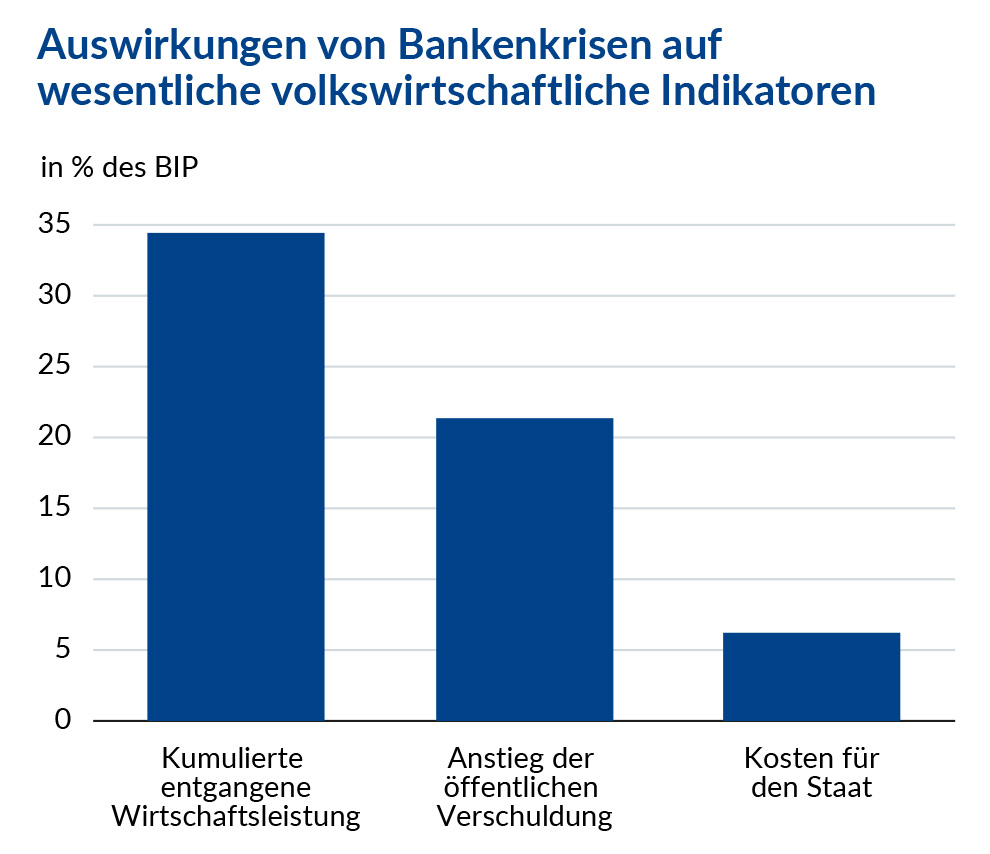
The social benefit of borrower-based measures is the fact that property market and banking crises can be averted. Banking crises may occur even when probabilities of default (PDs) seem to be low. The past has shown that even PDs between 2% and 4% are associated with property market crises. Banks’ funding costs are an important factor for the real economy. They are influenced by rating agencies, among others, who also take into account macroprudential measures. The Austrian banking system is currently in the third-highest rating category in Standard & Poor’s global ranking of banking systems (no country is in the top rating category). Unexpectedly high losses from real estate lending during an economic crisis are generally associated with a deterioration in balance sheets and credit ratings, leading to significantly higher refinancing costs for banks (Schmitz et al., 2019). These higher costs are passed on to customers taking out new loans (households, businesses, the government). Furthermore, increased refinancing costs may result in assets already held in the portfolio making a negative contribution to earnings, thereby causing banks’ equity capital to fall further (Leika et al., 2019). There is a risk of a downward spiral caused by rising refinancing costs, falling bank capitalisation and a further loss of confidence in the banking system, which in turn would drive up refinancing costs for banks and borrowers even further. In short, a crisis in the real estate market has negative consequences not only for banks but also for the real economy. And the social costs are even higher when property market and banking crises lead to bank failures (like, for example, in Ireland or in Spain 2008–14).