Credit transfers

Credit transfers move money from one bank account to another. In the euro area, credit transfers are among the most important forms of cashless payments. Within the Single Euro Payments Area (SEPA), transferring euro amounts is easy, fast and safe. It follows standardised rules and the costs involved are transparent and easy to compare.

Transferring money across Europe

Within the Single Euro Payments Area (SEPA), making euro payments from one bank account to another works the same way everywhere – for people and businesses, and for domestic and cross-border payments.

Good to know:
SEPA payments only work in euro. Separate conditions, processing periods and charges apply to credit transfers in other European currencies.

How SEPA credit transfers work

By SEPA credit transfer (SCT), you can transfer euro amounts from one bank account to another both within and across national borders within the SEPA region. A SEPA credit transfer must not take longer than one banking day. There is a cut-off time, however: After that, banks will only process payment orders on the following day.

Good to know: Payment orders outside the SEPA area must not take longer than two banking days.

How SEPA instant credit transfers work

If you really need to get things done quickly, you can pay by SEPA instant credit transfer (SCT Inst). Within the SEPA region, such payments take just a few seconds. SEPA instant credit transfers work 24/7/365.

What are the IBAN and the BIC?

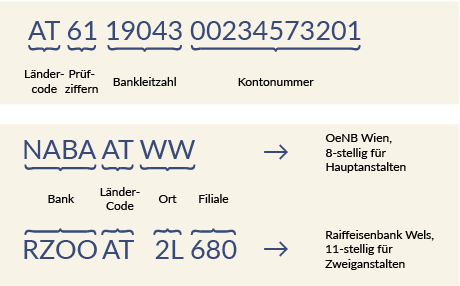
The IBAN is the International Bank Account Number. For euro payments within Austria and throughout the European Economic Area (EEA), you only need to provide the IBAN of the payee’s account (IBANonly).

  • You can find your own IBAN on your bank statements, on your bank cards and debit cards, or in your online banking portal on the internet. The IBANs of payees’ accounts can be found, for example, on their invoices or relevant payment slips. In Austria, the IBAN has 20 digits.

For payments to SEPA countries outside the EEA, such as Albania, Switzerland or the United Kingdom, you must provide the BIC as well as the IBAN. BIC is short for Business Identifier Code. It is a unique code used to identify banks worldwide.

  • You can find your bank’s BIC on your bank statements, on your bank cards and debit cards, or in your online banking portal on the internet. The BIC of recipient banks (e.g. the payees’ bank) can be found, for example, on invoices or relevant payment slips as well as in the BIC directory maintained by SWIFT, the Society for Worldwide Interbank Financial Telecommunication. The BIC can be 8 or 11 digits long.
IBAN-name check

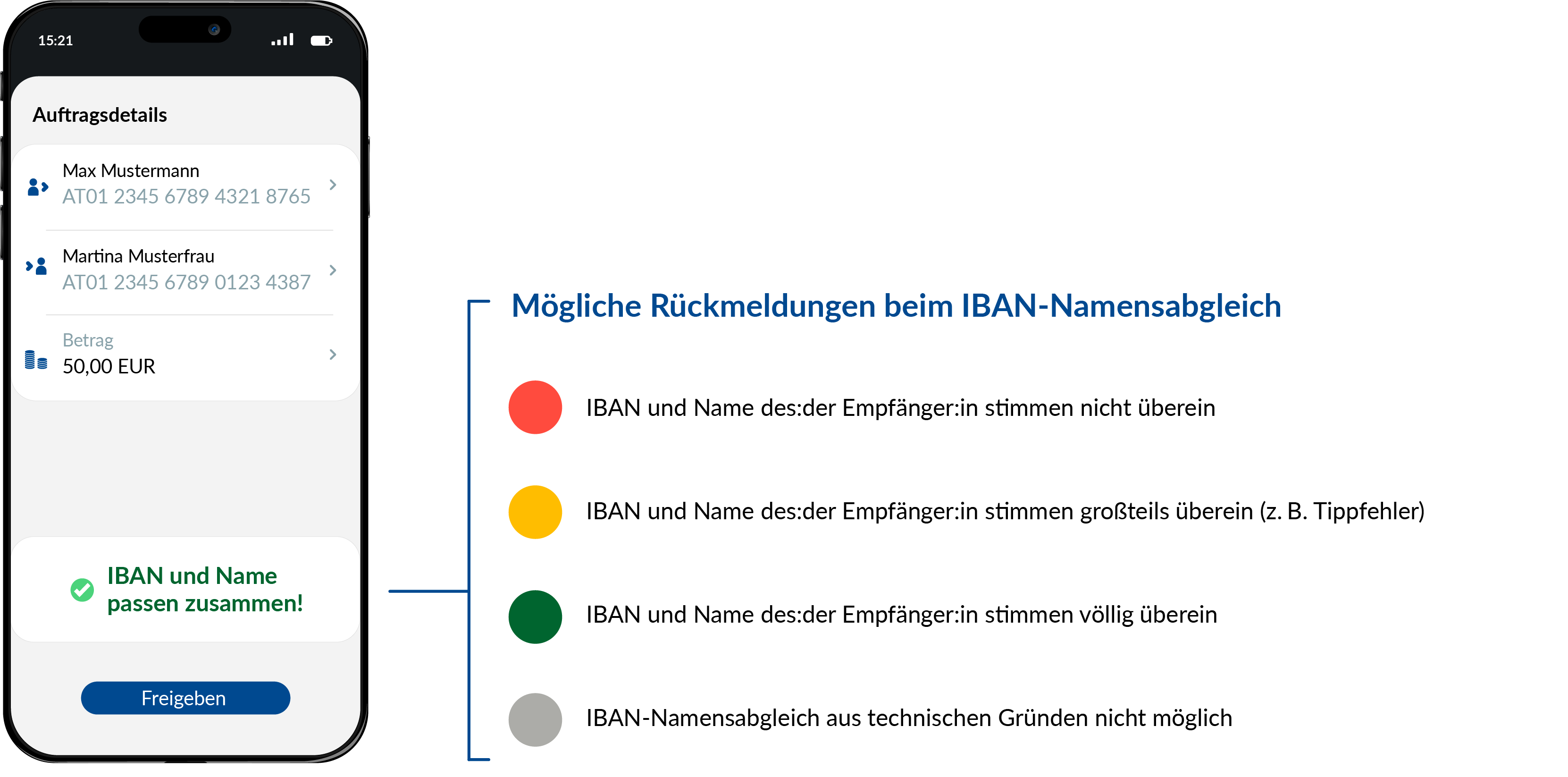
Before authorising a euro payment, banks must verify that the payee’s name and IBAN match. This is called IBAN-name check (verification of payee). This rule has been in force since October 2025. The IBAN-name check is carried out automatically and helps to prevent fraud and incorrect transfers.

Benefits of the IBAN-name check

Better fraud prevention

The IBAN-name check immediately detects incorrect account details provided by fraudsters. Payers can cancel the payment transaction in time.

Fewer incorrect transfers

The IBAN-name check highlights typing errors or accidental incorrect links in the payment order form. Payers can correct them straight away.

Results are flagged green, yellow and red

The IBAN-name check is quick and results are flagged: Green = Match. (Data are correct.) Yellow = Close match. (Corrections are required.) Red = No match. (Stop!)

Faster payments

Because the IBAN-name check automatically verifies account details, the payment itself is even faster.

Grey error checkmark

If account details could not be verified (e.g. due to technical problems), the results section is highlighted in grey. Payers can then decide for themselves whether they still wish to go ahead with the credit transfer.

Pay safely!

See below for useful tips for making secure payments.