Monetary policy
Monetary policy is our main task as a central bank. Our key objective is price stability. We all need price stability so our money keeps its value. To achieve this objective in the euro area, we can use a range of instruments. Which instruments we use, and when, is determined by the ECB Governing Council in its monetary policy decisions.

What is the aim of monetary policy?
Monetary policy affects us all. It has a big impact on how expensive our daily lives are and how much we can afford. That is why the primary objective of our monetary policy is price stability. In the Eurosystem, we talk about price stability when inflation is 2% over the medium term or, put differently, if prices in the euro area as a whole rise only slightly each year. This target is symmetric, meaning that negative and positive deviations of inflation from the target are equally undesirable. To achieve our price stability objective, we can use a range of instruments, which are decided upon jointly in the ECB Governing Council.
Specific objectives and decisions are guided by the Eurosystem’s monetary policy strategy.
The monetary policy strategy of the Eurosystem
A central bank’s monetary policy strategy provides the framework for all monetary policy decisions. The strategy sets out monetary policy objectives, the instruments available for the implementation of these objectives as well as the indicators which form the basis for monetary policy decisions. We review our strategy within the Eurosystem on a regular basis, taking into account changes in economic structures and new academic findings. That way we ensure that the monetary policy strategy fulfils its purpose – now and in the future.
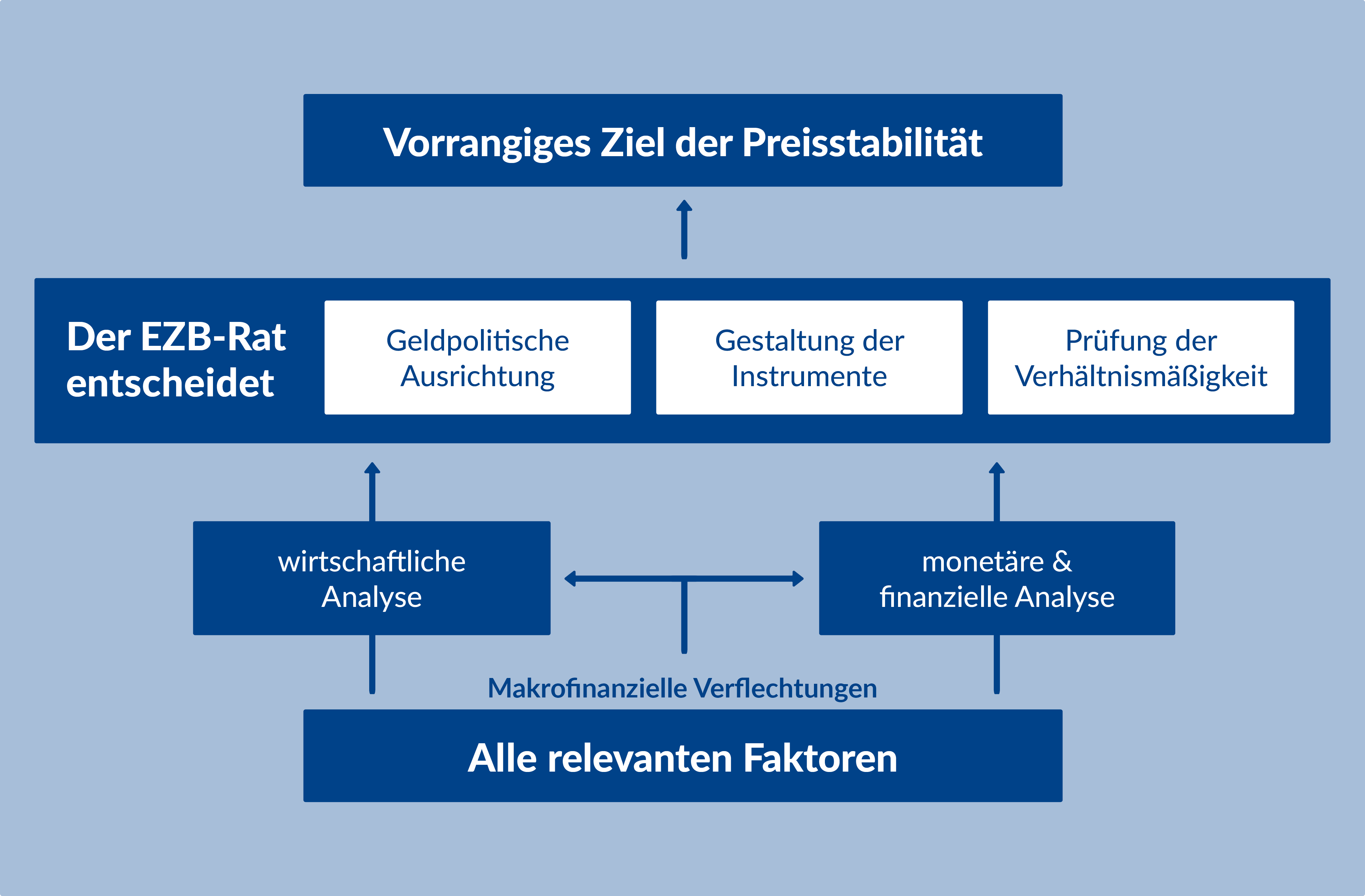
The basis for monetary policy decisions
Decisions on the use of monetary policy instruments are taken on the basis of a wide range of data and analyses. They are based primarily on two connected analyses:
Economic analysis: Economic analysis involves assessing the inflation outlook and the associated risks, against the backdrop of current economic and financial data. Inflation forecasts play a key role in this regard. However, inflation is also influenced by the state of the economy, among other factors, which is why analysing economic trends – for example in terms of gross domestic product (GDP) – is also important.
Monetary and financial analysis: This analysis looks at developments in lending and financial markets – and therefore also the state of the banking system. The banking system is one channel through which monetary policy decisions affect the real economy and, consequently, consumer prices. That is why we need a functioning banking system to pass on monetary policy signals. The most important aspect of these analyses is checking whether the transmission of monetary policy is working. In other words, we check whether the policy instruments we have chosen, such as changes in the key interest rate, are having the desired effect and influencing prices as intended. This transfer process is known as transmission. The analyses described above help us identify risks to medium-term price stability that may arise from financial imbalances and lending.
Stable financial markets – a must-have for effective monetary policy
Monetary policy and financial stability
Monetary policy works particularly well when the financial markets are fully integrated. This means that different countries or regions within the euro area link their financial markets in such a way that they function efficiently and seamlessly, just like a single market.
Why are well-functioning financial markets important for monetary policy?
Because they ensure that monetary policy signals reach all member states of a monetary union and take effect there. Financial markets are a key channel for ensuring that these monetary policy signals also reach businesses and households. Only then can monetary policy ensure price stability.
Therefore, it is one of the Eurosystem’s tasks to contribute to the stability of the financial system in addition to its primary objective of maintaining price stability.
Monetary policy decisions
The monetary policy decisions taken by the ECB Governing Council are designed to ensure price stability. Price stability is the primary objective of the Eurosystem’s monetary policy. The OeNB’s governor is Austria’s representative on the ECB Governing Council and thus contributes to controlling price growth in the euro area.
What are they about?
Monetary policy in the euro area is designed to ensure that inflation remains stable at 2% and that, hence, the euro broadly keeps its internal value. Central banks can influence prices by taking certain measures. It is precisely these measures – also known as monetary policy instruments – that are determined in monetary policy decisions. One important measure is the adjustment of key interest rates. But there are other monetary policy instruments as well.
-
Current key interest rates
as of: 16/09/26
Who takes the decisions?
Within the Eurosystem, all euro area countries decide on monetary policy together. The central bank presidents of the participating countries get together on the ECB Governing Council and take a vote. The OeNB’s governor casts a vote on these decisions as the independent representative of Austria. When preparing for monetary policy decisions, the governor relies on the OeNB’s economic analyses and forecasts.
The ECB Governing Council usually meets twice a month. However, it only takes monetary policy decisions every six weeks. That means that the monetary policy meetings of the ECB Governing Council take place eight times a year. At press conferences, the monetary policy decisions are explained in detail afterwards.
Procedure and rotating votes
The euro area was launched in 1999 with 12 participating countries. To date, 21 countries have adopted the euro as their currency. To ensure that the ECB Governing Council’s ability to act is not compromised by the increasing number of members, a rotation system for voting rights has been agreed. The members of the ECB’s Executive Board have one vote at each meeting. The presidents of the 21 participating central banks share 15 voting rights, which rotate over time.
Under the rotation regime, the euro area countries are divided into two groups according to size of their economies and their financial sectors. The central bank presidents of the countries ranked one to five share four votes. The remaining 16 countries hold 11 voting rights. The right to vote rotates monthly.
Monetary policy instruments in the Eurosystem
To keep inflation in the euro area at our target of 2%, we can use various monetary policy instruments. Put simply, we can take steps that influence how much the things consumers buy ultimately cost. Decisions on the use of monetary policy instruments are taken by the ECB Governing Council, where the OeNB is represented.
Key interest rates – our most important tool
Key interest rates are the most important monetary policy instrument for managing price movements in the euro area. We can use them to influence the interest rates that banks in the euro area charge when they lend money to each other. Via expectations, this in turn affects the overall level of interest rates across the euro area. These interest rates have an effect on the real economy and ultimately steer consumer prices.
Key interest rates affect consumer prices through various channels and in several stages; these are collectively referred to as the transmission mechanism. As there are many steps involved, it usually takes a while for monetary policy decisions to have a noticeable impact on consumer prices.
More on key interest ratesThe three key ECB policy rates – namely the interest rate on the deposit facility and the interest rates on the main refinancing operations and the marginal lending facility – are the prices for standard monetary policy operations through which commercial banks can deposit or borrow central bank money from the Eurosystem.
More on implementing monetary policyBefore the global financial crisis, monetary policy in the Eurosystem was primarily conducted through the setting of key interest rates. Sometimes a change in key interest rates is not enough to keep inflation stable at 2%. If key interest rates are close to their lower bound, the ECB Governing Council may, where appropriate, also steer monetary policy using other instruments. It has a large toolbox at its disposal for this purpose.
Monetary policy instruments outside the standard repertoire
In addition to key interest rates and standard operations, the ECB Governing Council may also use other instruments to steer price trends. This may become necessary when key interest rates are close to their lower bound, or in order to maintain the smooth transmission of monetary policy signals. Such instruments include negative interest rates, forward guidance, asset purchases and longer-term refinancing operations.
Negative interest rates
Negative key interest rates mean that banks have to pay interest on their deposits with other banks and receive interest on the loans they take out. This makes it cheaper for banks to raise funds. They pass on these cost savings to their customers in the form of lower interest rates on loans.
While the interest rate on the main refinancing operations was lowered in several steps in 2008/09 and from 2011 to 2016 until it reached 0% in March 2016, the interest rate for the deposit facility was reduced below 0% in 2014 for the first time. It was gradually reduced further to -0.5% in 2019. A negative interest rate on the deposit facility meant that, between 2014 and 2019, banks had to pay interest on their deposits with the Eurosystem – rather than receiving interest, as is usually the case in “normal” times.
Owing to the high level of excess liquidity, money market rates at that time were aligned with the deposit facility rate (the lower end of the key interest rate corridor), and money market rates were also pushed down to -0.5%.
Forward guidance
As part of forward guidance, a central bank aims to steer market expectations by communicating its future policy on key interest rates. This makes it possible for ECB policies to guide interest rate expectations beyond the short horizon, i.e. to steer not only the very short-term money market rates but longer maturities as well.
Forward guidance may be tied to a specific date or period of time. It may also be tied to certain conditions, so that markets are prepared for interest rates to change should a particular event occur (for example if a target value is reached).
The ECB Governing Council used forward guidance between 2013 and 2022. In 2013, for example, it emphasised that the ECB’s key interest rates would remain at current or lower levels for an extended period of time. In doing so, it anchored market expectations, which also kept money market interest rates in check beyond the very short term.
Asset purchases
Securities purchases may be made for a variety of reasons. For example, a central bank can use them to lower long-term interest rates. These purchases cause the prices of the securities to rise. As a result, their implied returns fall. New bonds can therefore be issued at a lower interest rate, which makes it easier for the economy to borrow. Particularly when key interest rates reach their lower bound, this instrument can help bring about a further reduction in interest rates (especially for longer maturities).
Longer-term refinancing operations with extended maturities
These operations were introduced by the Eurosystem, both in response to the global financial and economic crisis and during the COVID-19 pandemic, to ensure that banks were able to provide the real economy with sufficient credit.
The extended maturities make it easier for banks to refinance themselves and make it possible to plan for a longer term. In times of crisis, it is important for banks to have secure sources of funding. If banks were to become uncertain about their own refinancing, they, in turn, would become cautious about lending to households and businesses. In order to continue to provide the real economy with sufficient credit, banks need a reliable source of refinancing in times of uncertainty.
How we implement monetary policy
The Eurosystem uses a range of monetary policy tools to implement its monetary policy decisions. They are used to manage short-term market interest rates and liquidity within the banking system. This ensures a smooth transmission of monetary policy decisions to the economy.
Monetary policy decisions are implemented by the national central banks of the euro area. The European Central Bank (ECB) decides on the operations to be used and on the conditions to be applied. In Austria, the OeNB is responsible for carrying out monetary policy operations.
Open market operations
Open market operations – also known as tender operations – are transactions carried out by central banks through which they influence liquidity in the banking system and can thereby steer short-term money market rates to a level close to the key interest rate. By doing so, central banks can increase or reduce the available liquidity.
Main refinancing operations
The ECB’s standard tenders are designed to provide banks with money. The most important ones are the weekly tenders, also known as main refinancing operations. These tender operations take place every week and usually have a maturity of seven days. At present, these operations are conducted at a fixed interest rate, and banks receive the desired amount of central bank money provided they deposit sufficient collateral.
Longer-term refinancing operations
In addition, tender operations with a maturity of three months are offered once a month; these are also known as three‑month‑tenders. Through these operations, the ECB provides banks with longer-term liquidity. The interest rate applied corresponds to the average interest rate on weekly tenders, and here too, the banks receive the full amount of liquidity they request in return for collateral.
Operations in foreign currencies
A number of important central banks have joined forces and established mutual currency swap lines that are available as standing facilities. These serve as an important liquidity reserve to alleviate any tensions in the global financial markets. In the past, various liquidity-providing operations in foreign currencies have been offered based on this agreement. The Eurosystem currently conducts weekly tender operations in USD to provide liquidity, with a maturity of one week. These are not part of the standard tenders.
Standing facilities
Unlike open market operations, standing facilities are monetary policy operations carried out on the initiative of central banks’ counterparties. The Eurosystem offers two standing facilities: the marginal lending facility and the deposit facility. The marginal lending facility is in place to help counterparties meet their short-term liquidity needs. The deposit facility offers counterparties the possibility to deposit funds with the Eurosystem.
The main purpose of the standing facilities is to establish a corridor through which the overnight interest rates can be steered. As access to these facilities is not subject to any quantitative restrictions (apart from the collateral required for the marginal lending facility), the interest rate on the marginal lending facility and the interest rate on the deposit facility generally represent the upper and lower limit of the overnight rate on the money market. Changes to the interest rates on standing facilities generally have an immediate impact on overnight rates, such as the €STR.
Minimum reserves
The minimum reserve is a compulsory deposit that Austrian banks are required to hold on accounts with the OeNB. However, banks do not have to adhere strictly to the prescribed amount every day; instead, they can maintain it on average over a specific period. This enables banks to offset short-term fluctuations in liquidity using their own reserves without having to trade on the money market – for example, if large numbers of people suddenly withdraw cash. This helps prevent sharp fluctuations in interest rates. Stable money market rates enhance the clarity of monetary policy signals and make it easier for banks to plan their liquidity reserves.
The minimum reserve period spans a period of six to seven weeks, in line with the ECB Governing Council’s schedule for monetary policy meetings. The minimum reserve requirement is recalculated for each reserve maintenance period on the basis of specific customer deposits. The OeNB checks whether Austrian banks are complying with their minimum reserve requirements. If a bank holds insufficient funds in its minimum reserve account, the requirement is deemed not to have been met and the OeNB may impose a penalty on behalf of the ECB. Since December 2023, the ECB has been publishing details of such penalties on its website.
Eurosystem collateral framework
Banks that are counterparties of the OeNB may participate in the Eurosystem’s monetary policy operations. This means that banks can obtain liquidity from the Eurosystem via the OeNB if they provide collateral of sufficient quantity and quality in return. The assets that can be used as collateral may be marketable (e.g. bonds) or non-marketable (credit claims) and may be used throughout the Eurosystem. For assets to be considered eligible as collateral, they must meet the eligibility criteria laid down by the Eurosystem, which are set out in a number of guidelines.
Collateral is managed via the Eurosystem Collateral Management System, a joint IT system operated by the central banks of the euro area and part of the TARGET Services.
Monetary policy operations beyond the standard toolkit
Longer-term refinancing operations with extended maturities
While the refinancing operations in the Eurosystem’s standard repertoire have maturities of one week or three months, the maturities of these operations may be longer. In the past, the Eurosystem has offered extended maturities ranging from one month to four years.
Asset purchases
Under its asset purchase programmes, the Eurosystem may buy various types of assets. In the past, it has mainly acquired government bonds and, to a lesser extent, corporate bonds, covered bonds issued by banks and asset-backed securities.